Modern smartphones have fundamentally evolved into high-performance digital cameras that happen to make phone calls. Whether documenting family milestones, creating video content, scanning payment codes, or connecting with colleagues across remote video conferences, clear lenses and responsive image sensors are central to everyday life. When you open your camera application only to encounter a black viewfinder, violent optical vibrations, blurry focus, or a fractured lens cover, your mobile workflow stops in its tracks.
Experiencing hardware failures with a smartphone camera introduces an immediate technical dilemma: should you repair the existing optics, replace an individual sensor, or pay for an entire phone swap? Navigating a damaged phone camera requires understanding the vast engineering differences between the front selfie camera array and the complex rear multi-lens module. While both capture digital imagery, their mechanical construction, biometric security integrations, optical stabilization systems, and repair costs differ significantly.
Independent repair specialists like DC Phone Repair in Washington DC provide fast, dependable, and low-cost camera solutions across Apple iPhone, Samsung Galaxy, Google Pixel, and Motorola devices. By diagnosing failures down to the component level—such as replacing cracked exterior sapphire glass, micro-soldering TrueDepth sensors, or installing factory-calibrated OEM sensor modules—local technicians restore pristine photography in under two hours while saving you hundreds of dollars compared to official manufacturer replacement fees.
Engineering Anatomy: Front Camera vs. Back Camera Modules
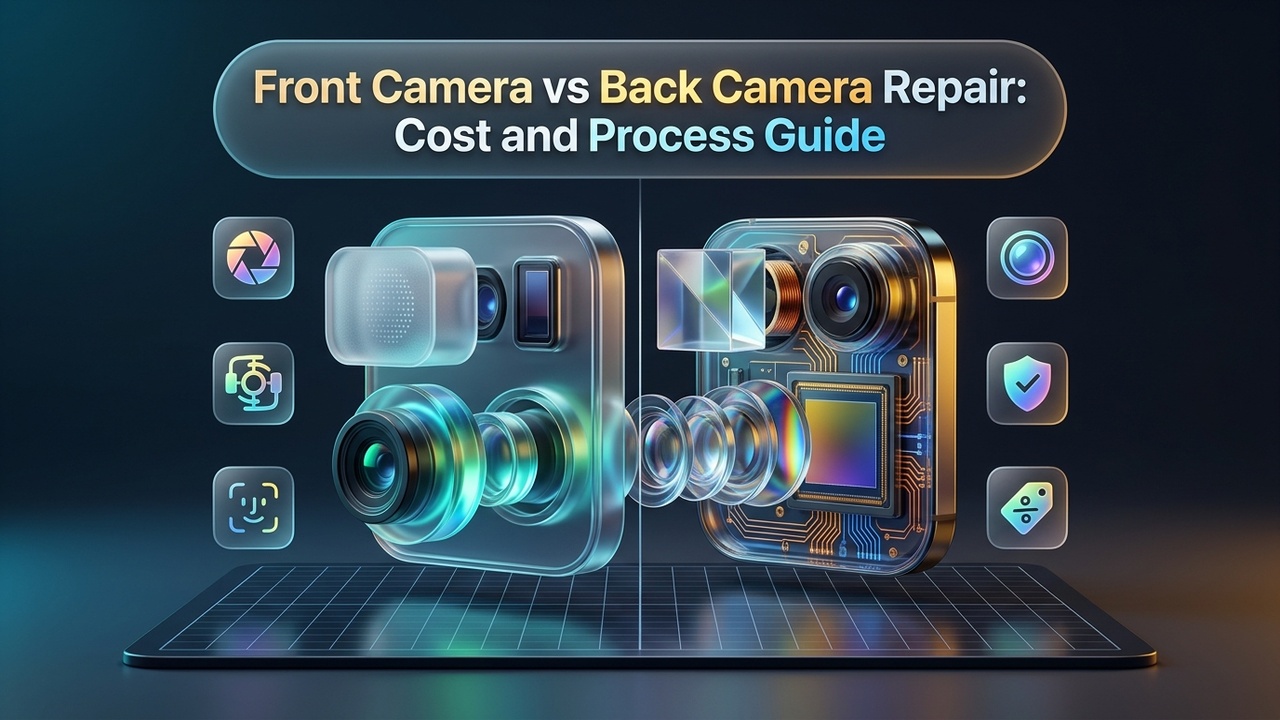
To understand why camera repair costs and procedures vary so widely, one must first examine the distinct optoelectronic engineering behind front and rear smartphone optics. Modern smartphones isolate these systems into two completely separate hardware assemblies with distinct operational demands.
1. The Front-Facing (Selfie) Camera Array
The front camera module is designed for compact efficiency, fitting into the microscopic top bezel or display cutout (such as Apple's Dynamic Island or Android punch-hole displays). Key technical characteristics include:
- Integrated Biometric Sensors: On modern Apple iPhones, the front camera is not an isolated component; it is integrated into the complex TrueDepth sensor array comprising an infrared (IR) camera, flood illuminator, ambient light sensor, and microscopic dot projector. These elements beam and read over 30,000 invisible infrared dots to map facial geometry for Face ID security.
- Cryptographic Motherboard Pairing: Apple cryptographically pairs the TrueDepth Face ID flex cable to the device's secure enclave processor. Swapping the front camera flex with an uncalibrated replacement without micro-soldering the original biometric chips permanently disables Face ID.
- Compact Optical Stack: Most front cameras feature a fixed-focus or lightweight dual-pixel autofocus lens stack without heavy physical optical image stabilization (OIS) magnets, making them mechanically simpler but electronically more sensitive to moisture and micro-tears.
2. The Rear Multi-Camera Module Array
In contrast, the rear camera cluster is a massive, multi-tiered electro-mechanical powerhouse occupying a large portion of the upper phone chassis. Modern flagships feature two to four specialized sensors working in unison:
- Large-Format Primary CMOS Sensors: Flagship rear cameras feature massive image sensors (up to 1-inch sensor sizes or 200 megapixels) capable of capturing immense light data across low-noise pixel bins.
- Voice Coil Motor (VCM) Optical Image Stabilization: To eliminate handheld blur and stabilize 4K/8K video, primary and telephoto rear sensors are suspended inside a microscopic magnetic gimbal. Tiny copper voice coils and neodymium magnets float the lens barrel or the sensor itself (sensor-shift OIS), reacting thousands of times per second to counteract physical shakes.
- Periscope Telephoto Prisms: High-zoom lenses (3x, 5x, and 10x optical zoom) utilize a sideways-mounted folded periscope optical design, bouncing light off a precision glass prism through motorized stepper lenses to achieve telephoto reach without protruding inches out of the phone.
- Protective Sapphire Glass Lenses: The rear modules sit underneath raised exterior glass lenses bonded to the rear housing frame, shielding the delicate internal aperture mechanisms from dust and direct impact.
Because the rear camera contains heavy mechanical moving parts (magnets, springs, and prisms), it is far more vulnerable to physical impact shock and mechanical vibrations than the static front camera. Let us look at the most common failure modes technicians diagnose on the repair bench.
Common Front Camera Failure Modes & Diagnostic Signs
When a front-facing selfie camera develops faults, symptoms generally present in three distinct categories:
1. The Black Viewfinder or App Crashing Upon Flipping
A classic failure mode occurs when the rear camera functions normally, but tapping the camera flip icon causes the viewfinder to freeze, display pure black, or crash the camera app back to the home screen. This typically stems from a fractured internal ribbon cable, liquid intrusion through the top earpiece speaker mesh, or a blown low-dropout (LDO) power management rail on the logic board delivering 2.8V analog power to the front sensor.
2. Blurry, Hazed, or Milky Selfies
If your front camera pictures look foggy, washed-out, or milky under sunlight, the issue is often physical contamination rather than electrical sensor failure. After a screen replacement or front impact, microscopic dust, pocket lint, or condensed liquid cleaning spray can seep underneath the display's top glass portal, settling over the camera lens. A professional cleanroom inspection and lens cleaning often completely restores optical clarity without requiring a new camera module.
3. "Face ID Is Not Available" / Biometric Failure
On Apple iPhones, a severe front impact or liquid ingress often damages the delicate glass prism of the dot projector or the infrared camera. When this happens, iOS displays an alert: "A problem was detected with the TrueDepth camera. Face ID has been disabled." Standard replacement cameras cannot fix this issue on their own; it requires specialized micro-soldering to transfer the original cryptographically paired security ICs onto a fresh sensor flex cable.
Common Back Camera Failure Modes & Diagnostic Signs
Rear cameras experience intense mechanical and environmental stresses, leading to several signature hardware breakdowns:
1. The "Vibrating / Buzzing Camera" (Broken OIS Suspension)
By far the most common rear camera malfunction is a camera that buzzes loudly, emits a high-pitched clicking noise, and displays a violently shaking, wavy image—often called the "jello effect." This failure occurs when the microscopic suspension springs holding the Voice Coil Motor (VCM) snap or when the magnetic position sensors fail.
Primary Cause: Motorcycle and Scooter Handlebar Vibrations: High-frequency, high-amplitude vibrations transmitted through motorcycle, moped, or bicycle handlebars directly destroy the delicate OIS springs inside smartphone cameras. Even a single 30-minute ride without a vibration-dampening mount can permanently ruin a phone's rear optical stabilization. When this happens, the entire rear camera module must be replaced.
2. Cracked Exterior Camera Lens Glass
Because rear camera lenses protrude outward on modern camera bumps, dropping a phone onto asphalt or gravel frequently shatters the exterior protective glass circle. Many users ignore a small crack if the camera still takes pictures. However, leaving cracked camera glass unaddressed is a critical mistake: fractured glass exposes the microscopic, coated objective lens and focusing motor directly to airborne dust, humidity, and pocket sand. Within days, abrasive dust particles enter the voice coil motor, permanently scratching the sensor filter and jamming the focus gears.
3. Autofocus Hunting & Inability to Focus at Distance
If your camera focuses perfectly on objects two inches away (macro mode) but remains completely blurry when trying to photograph people or landscapes across the room, the voice coil focusing actuator has seized. Drops can bend the microscopic guide pins inside the lens barrel, preventing the stepper motor from driving the lens elements along their focal track.
4. Dark Purple Spots or Permanent Black Blemishes
If your photos show permanent translucent gray smudges or dark purple laser burn spots across every picture, the CMOS sensor silicon itself has suffered permanent physical trauma. This often happens after exposure to high-powered event lasers (such as concert lighting or barcode scanners) which instantly burn microscopic pits into the photosensitive silicon matrix, requiring full camera module replacement.
Exterior Camera Glass vs. Internal Module Replacement
One of the most important distinctions that saves consumers substantial money is knowing whether their device requires a simple exterior camera glass replacement or a full internal camera module swap:
Scenario A: Exterior Camera Glass Replacement Only (Low Cost)
If you dropped your phone and shattered the circular glass window on the back of the case, but your camera app still opens instantly, focuses crisply, and produces clear images without spots or buzzing, your internal camera module is completely healthy. Technicians can carefully remove the fractured glass shards from the outside, clean the internal lens in an anti-static cleanroom hood, and bond a brand-new OEM sapphire crystal lens ring. This repair is extremely fast (30 to 45 minutes) and very low cost, protecting your underlying multi-hundred-dollar camera sensor from future damage.
Scenario B: Full Internal Camera Module Replacement
If the camera produces a black screen, vibrates violently, refuses to focus, or displays permanent internal purple spots, the internal camera module itself has failed. Technicians must open the smartphone, disconnect internal battery lines, unseat shielded camera flex cables, extract the failed optical assembly, and install a brand-new factory module.
Front vs. Back Camera Technical Comparison Matrix
The following technical matrix outlines the key structural, optical, and repair differences between front and rear smartphone camera assemblies:
| Engineering Metric | Front (Selfie) Camera Array | Rear Multi-Camera Module Cluster |
|---|---|---|
| Optical Complexity | Single lens stack (Fixed or Dual-Pixel AF) | Dual, triple, or quad modules with periscope optical zoom |
| Image Stabilization | Electronic Image Stabilization (EIS via software) | Mechanical Voice Coil Motor (VCM) / Sensor-Shift OIS |
| Biometric Security Link | Tightly paired to Face ID / IR Flood Illuminator | Independent imaging sensor (No biometric pairing locks) |
| Vulnerability to Shaking | Extremely low (No floating magnetic suspension) | High (Vibrations snap microscopic OIS gimbal springs) |
| Repair Specialization | Micro-soldering required to preserve Face ID pairing | Cleanroom lens extraction; optical sensor alignment |
| Common Failure Culprit | Liquid intrusion through earpiece; cracked screen flex | Motorcycle handlebar vibration; cracked exterior sapphire glass |
Cost Breakdown: Manufacturer Repair Depots vs. DC Phone Repair
Official manufacturer service pricing for camera repairs is notoriously expensive. Brands like Apple and Samsung frequently classify camera malfunctions under broad "Other Damage" tiers if you do not carry active monthly insurance subscriptions. In many instances, if your back camera vibrates or your lens glass cracks, manufacturer depots charge between $249 and $449—often forcing customers into full refurbished device replacements that erase personal data and require weeks of shipping turnaround.
In contrast, DC Phone Repair performs precision component-level surgery. If only your exterior camera glass is cracked, we replace the glass for a fraction of the cost. If a rear sensor has failed, we replace only that modular unit with certified OEM hardware, preserving your motherboard, biometric data, and personal files while saving you up to 65%.
| Camera Service Category | Manufacturer Out-of-Warranty Depot | DC Phone Repair Affordable Rate | Direct Customer Savings |
|---|---|---|---|
| Exterior Rear Camera Glass Replacement | $199.00 – $299.00 (Requires full chassis swap) | $49.00 – $69.00 (Same-day 30-minute fix) | Save up to $230; original sensor preserved; fast walk-in |
| Front Selfie Camera Replacement (Standard) | $199.00 – $249.00 (Mail-in depot fee) | $69.00 – $89.00 (Same-day 1-hour service) | Save up to $160; crystal-clear video calls restored |
| TrueDepth Front Camera & Face ID Repair | $299.00 – $399.00 (Whole-unit swap policy) | $109.00 – $149.00 (Micro-soldering chip transfer) | Save up to $250; biometric security retained without errors |
| Rear Primary Camera Module (iPhone / Galaxy) | $249.00 – $349.00 (Out-of-warranty depot) | $89.00 – $139.00 (OEM module with OIS) | Save up to $210; fixes buzzing OIS & focusing lockouts |
| Flagship Periscope Telephoto Module | $329.00 – $449.00 (Depot service tier) | $139.00 – $179.00 (Exact OEM prism module) | Save up to $270; 10x optical zoom restored cleanly |
The 5-Stage Professional Camera Repair Workflow at DC Phone Repair
Servicing delicate smartphone optics requires specialized cleanroom discipline to ensure that not a single microscopic speck of dust settles between the image sensor and the lens elements. At DC Phone Repair, technicians execute a meticulous five-stage restoration protocol:
Stage 1: Multi-Lens Optical & Sensor Telemetry Diagnostic
Technicians open hardware diagnostic software to test each sensor independently. We check the ultra-wide, standard wide, and telephoto lenses individually, measure OIS gyro feedback across physical tilts, test laser autofocus emission, and inspect front infrared dot projector integrity.
Stage 2: Precision Thermal Disassembly & Static Grounding
The smartphone is heated on an automated temperature-controlled separator to soften perimeter water-resistant seals without overheating the battery. Inside our anti-static ESD cleanroom environment, technicians disconnect the battery before unseating delicate camera flex connectors from the logic board.
Stage 3: Cleanroom Decontamination & Sensor Micro-Soldering
Under a laminar flow clean air hood, technicians remove the damaged camera assembly. If servicing an iPhone TrueDepth front camera, technicians use stereomicroscopes and micro-soldering hot tweezers to desolder the encrypted dot projector IC from the torn cable, transferring it cleanly to an OEM replacement flex to preserve native Face ID functionality.
Stage 4: OEM Module Installation & OIS Gyro Calibration
A certified, factory-original camera module is installed into the chassis housing. Connectors are seated and secured with EMI shielding brackets. If replacing cracked exterior camera glass, technicians apply specialized optical epoxy to bond high-strength sapphire glass, ensuring a dust-tight and moisture-resistant seal.
Stage 5: Macro, Telephoto & Low-Light Stress Calibration
Before closing the device, technicians run automated camera calibration routines to verify focus tracking across near and far test targets, check color balance against standard color checker charts, verify 60fps/120fps video stabilization, and ensure zero stuck pixels or haze across low-light exposures.
Why DC Phone Repair Is Washington DC's Trusted Destination for Phone Service
Smartphone owners across Washington DC, Capitol Hill, Anacostia, Navy Yard, and Northern Virginia choose DC Phone Repair because we deliver technical precision with transparent, affordable pricing:
- Significant Cost Savings: By repairing components surgically—such as swapping broken camera glass for just $49—we save our customers up to 70% compared to manufacturer flat replacement tiers.
- Fast Same-Day Service: Most camera glass and module repairs are completed within 45 to 90 minutes, getting your photography back online the same afternoon.
- Zero Data Loss Guarantee: We work strictly on your optical hardware. Your photos, contacts, private apps, and operating system remain 100% secure and untouched.
- Comprehensive 90-Day Warranty: Every replacement camera module and lens glass installation is protected by our ironclad 90-day parts and labor warranty against defects or focusing errors.
- Full Device Mastery: In addition to camera restorations, our certified engineers handle comprehensive phone services, including OEM vs aftermarket screen repair, Samsung camera troubleshooting, and general certified phone repair services.
Restore Your Smartphone Camera Today at DC Phone Repair
Don't let a cracked lens, vibrating viewfinder, or unresponsive selfie camera ruin your photos and video calls. Whether your phone suffered a sudden drop, motorcycle vibration damage, or dust accumulation, our certified technicians are ready to restore crystal-clear photography today at unbeatable low prices.
Walk in directly, call our technicians, or schedule your repair online for a free, transparent diagnostic estimate:
DC Phone Repair
2704 Marion Barry Ave SE,
Washington DC 20020, United States
Phone: (202) 478-4799
Website: https://dcphonerepair.com/
Hours: Open Daily from 10:00 AM – 10:00 PM
Frequently Asked Questions About Phone Camera Repair
How long does a smartphone camera repair or lens glass replacement take?
At DC Phone Repair, replacing a cracked exterior camera glass lens typically takes just 30 to 45 minutes. A complete front or rear internal camera module replacement usually takes between 1 and 2 hours. Because we stock OEM-spec camera modules and sapphire lens glass for popular iPhone, Samsung Galaxy, and Google Pixel models in-house, most customers receive same-day walk-in turnaround.
Why is my smartphone rear camera vibrating and making a buzzing noise?
A buzzing, vibrating camera is caused by broken mechanical suspension springs or failed position sensors inside the Optical Image Stabilization (OIS) voice coil motor. This damage most frequently occurs when a phone is mounted on motorcycle, moped, or bicycle handlebars, where high-frequency engine and road vibrations destroy the miniature magnetic gimbal. The internal camera module must be replaced to fix the issue.
Can you replace just the cracked glass over my camera without replacing the camera itself?
Yes. If your camera still opens, focuses properly, and takes clean pictures without dark spots, you only need an exterior camera glass replacement. Our technicians remove the broken glass fragments, decontaminate the lens in an anti-static cleanroom hood, and install a brand-new sapphire crystal lens for as low as $49, saving you from purchasing a whole new camera assembly.
Will replacing the front camera disable Face ID on my iPhone?
On Apple iPhones, standard third-party camera swaps will disable Face ID because the TrueDepth biometric sensors are cryptographically paired to the motherboard. However, at DC Phone Repair, our certified micro-soldering technicians can safely desolder and transfer your original encrypted dot projector and infrared sensors onto a new replacement flex cable, preserving your Face ID functionality without error messages.
Why are my camera photos blurry or failing to focus at a distance?
If your camera focuses on close objects but stays blurry when looking at distant subjects, the voice coil focusing actuator has likely jammed or suffered physical impact displacement. In other cases, dust or moisture has seeped inside a cracked exterior lens cover, coating the optical sensor. Our technicians can diagnose whether a cleanroom lens cleaning or a full module replacement is required.
Need Fast & Reliable Device Repair in Washington, DC?
Don't let a cracked screen, dying battery, or faulty charging port slow you down. Our certified technicians provide same-day diagnostics and repairs using premium replacement parts backed by our comprehensive warranty.
Phone: (202) 478-4799 | Open Daily: 10:00 AM - 10:00 PM