Few everyday mishaps cause an instant sinking feeling quite like watching an iPhone tumble facedown onto concrete. Whether you pick it up to reveal hairline fractures across the glass, erratic green flickering vertical lines, or a completely unresponsive black screen, the next decision invariably comes down to replacement hardware. Walking into the repair marketplace introduces an immediate, perplexing dilemma: should you pay top dollar for an authentic OEM panel, or choose an aftermarket replacement to keep costs manageable?
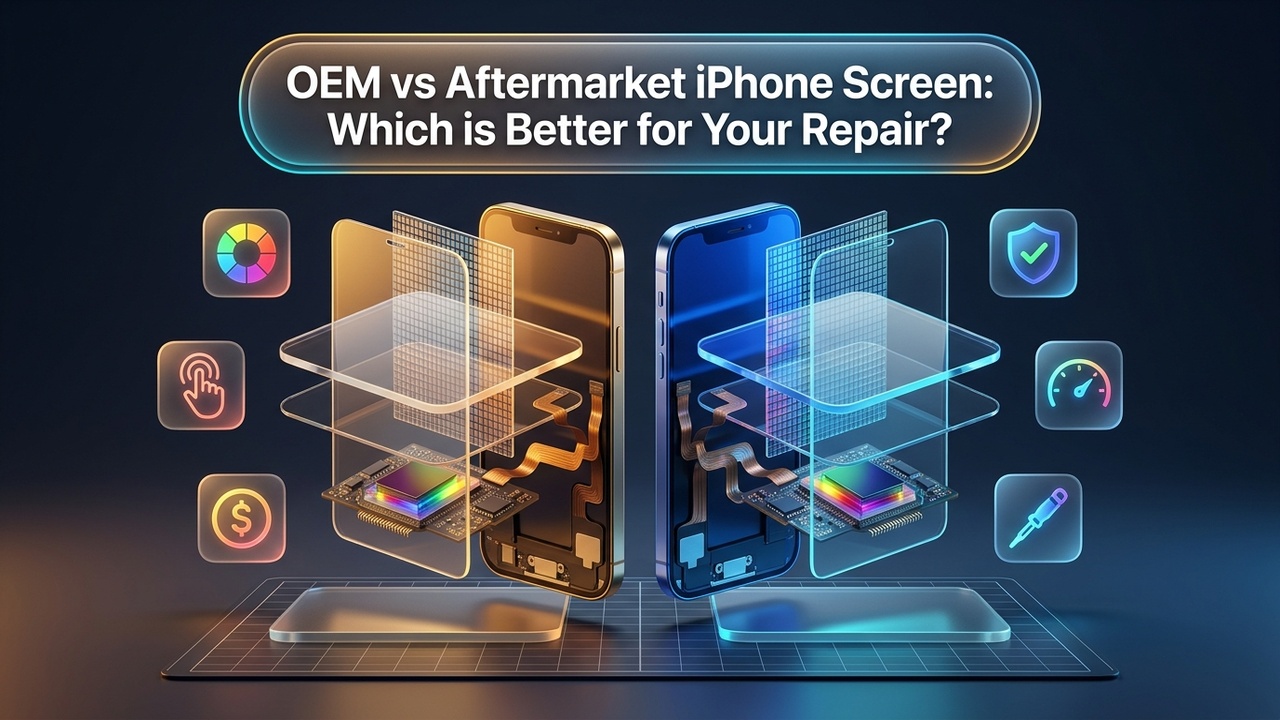
The debate surrounding an oem vs aftermarket iphone screen is not simply a matter of high price versus low price. Modern smartphone displays are intricate multi-layered optoelectronic engineering systems comprising polarized coatings, capacitive touch digitizers, optical clear adhesives, flexible OLED matrices, ambient light sensors, and microscopic integrated display driver circuits (DDIC). Choosing the right replacement directly affects color reproduction, sunlight legibility, touch sampling responsiveness, ProMotion refresh rates, battery consumption, and how iOS interacts with the installed panel.
Understanding the technical architecture behind genuine Apple displays and contemporary third-party engineering allows device owners to make informed, financially sound choices. By partnering with certified local repair specialists such as DC Phone Repair, consumers can secure premium display quality, factory-calibrated color accuracy, and dependable warranty protection at rates significantly lower than Apple Store out-of-warranty replacement pricing.
Understanding Display Terminology: OEM vs. Aftermarket
To evaluate an oem vs aftermarket iphone screen fairly, one must first deconstruct the terminology used throughout the electronics refurbishment industry. The repair market does not deal in a simple binary choice between "genuine" and "fake." Instead, replacement screens exist across a spectrum of quality grades, manufacturing origins, and refurbishment methods.
1. What Is an OEM iPhone Screen?
OEM stands for Original Equipment Manufacturer. When applied to an iPhone display, this refers to panels manufactured to Apple's exact proprietary specifications by authorized Tier-1 display fabrication partners, historically including Samsung Display, LG Display, and Japan Display Inc. (JDI). Genuine OEM displays feature:
- Full DCI-P3 Wide Color Gamut: Delivering 100% color fidelity, true-to-life skin tones, and deep color saturation without oversaturation or blue color casts.
- Precision Calibrated Luminance: Achieving native factory peak brightness ratings exceeding 800 to 1,000 nits in typical viewing and reaching up to 2,000 nits peak outdoor brightness on newer Pro models.
- Original Diamond PenTile OLED Matrix: Uniform subpixel geometry ensuring razor-sharp text, smooth anti-aliased graphics, and zero subpixel fringing.
- Native True Tone & Ambient Calibration: Seamless EEPROM communication with iOS ambient light sensors for continuous color temperature adaptation.
- Optimized Power Management: Driver IC firmware programmed to maximize battery life, preventing parasitic drain from inefficient backlighting or erratic refresh timing.
2. The Reality of Refurbished OEM Displays
Because Apple maintains tightly controlled supply chain distribution, many authentic screens installed by reputable independent repair facilities are classified as "Refurbished OEM" or "OEM Pulls." An OEM pull is an authentic Apple display salvaged intact from an undamaged device. An OEM refurbished display is an original Apple OLED or LCD panel where only the cracked top protective glass was shattered; technicians in cleanroom environments use specialized cryogenic freeze separators, laser wire cutters, and optical clear adhesive (OCA) laminators to replace the exterior glass while preserving the original Apple OLED substrate, touch digitizer, and driver IC underneath. This hybrid approach delivers authentic factory visual performance at a substantial discount.
3. What Is an Aftermarket iPhone Screen?
An aftermarket screen is manufactured entirely by an independent third-party fabrication company without Apple's direct involvement. Rather than salvaged parts, these displays are built from scratch to reverse-engineered specifications. Decades ago, aftermarket replacement screens had an unenviable reputation for dull backlights, washed-out colors, and thick glass borders. Over the past five years, however, leading third-party display manufacturers have invested millions in automated cleanroom fabrication lines, creating distinct tiers of aftermarket technology:
- Soft OLED Aftermarket: The gold standard in third-party engineering. Built upon a flexible polyimide substrate identical to Apple's original architecture, Soft OLED panels feature curved edge profiles, ultra-thin bezels, superior drop shock resistance, and vibrant contrast.
- Hard OLED Aftermarket: Built upon a rigid glass substrate instead of flexible plastic. Hard OLED panels offer excellent contrast and deep true blacks at a lower cost than Soft OLED, but feature marginally thicker bottom chin bezels and greater vulnerability to internal hairline cracks upon severe impact.
- In-Cell LCD Aftermarket: An ultra-budget option primarily used for older OLED-based devices (such as iPhone X or iPhone 11 Pro). These convert an OLED design into an LCD panel with an active LED backlight. While inexpensive, they consume more battery power, feature thicker borders, and cannot produce true pitch blacks.
| Specification Metric | Original Factory OEM | Premium Soft OLED | Rigid Hard OLED | Budget In-Cell LCD |
|---|---|---|---|---|
| Substrate Structure | Flexible Polyimide OLED | Flexible Polyimide OLED | Rigid Glass OLED | Liquid Crystal with Backlight |
| Color Reproduction | 100% DCI-P3 (Delta-E < 1.0) | 92%–96% DCI-P3 Gamut | 85%–90% sRGB / P3 | 70%–80% sRGB Only |
| Peak Outdoor Brightness | 800–2000 Nits | 650–850 Nits | 550–700 Nits | 450–550 Nits |
| Bezel / Chin Thickness | Original Ultra-Thin | Matches OEM Dimensions | +0.3mm to +0.5mm Chin | +0.8mm to +1.2mm Border |
| Drop Shock Durability | Exceptional (Resilient Flex) | High (Flexible Layer) | Moderate (Brittle Matrix) | Low to Moderate |
| Battery Power Efficiency | Factory Calibrated (100%) | Excellent (95% Efficiency) | Good (90% Efficiency) | Reduced (Backlight Drain) |
| Touch Sampling Rate | 240Hz Instant Response | 180Hz–240Hz Smooth | 120Hz–180Hz Good | 120Hz Basic Response |
| Relative Price Range | Highest ($180–$380) | Balanced ($89–$179) | Economical ($69–$139) | Lowest ($49–$89) |
Core Technical Differences Explored in Depth
When weighing an oem vs aftermarket iphone screen for an upcoming repair, looking beyond surface appearance reveals vital performance distinctions. Everyday use exposes differences across several critical categories:
1. Display Brightness and Outdoor Usability
One of the clearest real-world tests for any phone screen is direct outdoor sunlight. Genuine OEM displays utilize advanced emitters capable of high peak nit thresholds. On modern flagships like the iPhone 13 Pro, iPhone 14 Pro, or iPhone 15 Pro, OEM screens seamlessly push beyond 1,000 nits in high ambient brightness mode, reaching up to 2,000 nits during intense outdoor exposure.
Quality Soft OLED aftermarket panels produce around 650 to 850 nits. In typical indoor and shaded outdoor environments, this provides crisp, vibrant, easily readable images that 95% of users find completely satisfying. However, budget Hard OLED or low-tier LCD replacements often top out at 450 to 550 nits, which can feel dim and washed out under bright direct midday sun. When selecting an aftermarket replacement, prioritizing high-tier Soft OLED ensures strong daylight performance.
2. True Tone, Ambient Light & ProMotion Calibration
Beginning with the iPhone 8 and extending through all current models, Apple links the display assembly to the motherboard via encrypted cryptographic serial numbers stored in the display microcontroller. When a screen is detached and a new one installed without proper diagnostic EEPROM programmer tools:
- True Tone Disablement: The ambient color temperature balancing feature automatically disappears from the iOS Control Center and Display Settings.
- Auto-Brightness Malfunction: The ambient light sensor may fail to dynamically adjust brightness in changing lighting conditions.
- 120Hz ProMotion Throttling: On Pro and Pro Max variants, inferior display driver chips can cause the variable refresh rate to stutter or lock at 60Hz.
At DC Phone Repair, our experienced technicians use specialized hardware programmers to read the unique calibration data from your cracked screen and flash it directly to the new replacement panel. Whether you opt for an authentic OEM assembly or a premium Soft OLED aftermarket screen, our programming process preserves full True Tone functionality, smooth auto-brightness responsiveness, and flawless touch sensitivity.
3. Glass Durability, Bezel Fit, and Ceramic Shield
Apple's OEM screens feature specialized Ceramic Shield formulation, developed in partnership with Corning, which incorporates nano-ceramic crystals into the glass matrix for fourfold drop resistance. OEM screens also feature microscopic oleophobic coatings baked into the glass surface, repelling skin oils and fingerprint smudges while providing a silky, frictionless touch swipe.
Premium aftermarket manufacturers utilize chemically strengthened aluminosilicate glass with vacuum-deposited oleophobic layers. While slightly more prone to superficial micro-scratches if carried in pockets with keys or coins, their impact durability is remarkably close to OEM glass when paired with an inexpensive tempered glass protector. Conversely, bottom-tier aftermarket glass tends to be brittle, lacks quality oil-repellent coatings, and often presents slightly thicker bezels along the bottom edge (the "chin").
4. Touch Digitizer Sampling and Gaming Responsiveness
For casual texting, social media browsing, and email, both OEM and quality aftermarket panels provide responsive, lag-free interaction. However, high-speed mobile gamers (playing titles like Call of Duty Mobile, PUBG, or competitive rhythm games) may notice a subtle difference in touch sampling rates. OEM screens register finger input at 240Hz, translating to instant aiming adjustments and fluid multi-touch gesture processing. High-end aftermarket Soft OLED panels maintain a robust 180Hz to 240Hz sampling rate, while budget clones often sample at 120Hz, resulting in occasional micro-delays during rapid multi-finger gestures.
Real-World Cost Comparison: Apple Store vs. Local Independent Repair
The cost disparity between Apple Store direct out-of-warranty replacements and local independent service is the single biggest motivator driving the oem vs aftermarket iphone screen decision. Apple's authorized pricing structure often treats out-of-warranty screen replacements as major capital expenditures, sometimes approaching 50% to 60% of the entire device's remaining market value.
| iPhone Model | Apple Out-of-Warranty Fee | DC Phone Repair OEM / Refurb | DC Phone Repair Premium Aftermarket | Average Customer Savings |
|---|---|---|---|---|
| iPhone 11 (LCD) | $199.00 | $89.00 – $99.00 | $69.00 – $79.00 | Save $100–$130 (55%–65%) |
| iPhone 12 / 12 Pro | $279.00 | $139.00 – $159.00 | $89.00 – $109.00 | Save $140–$190 (50%–68%) |
| iPhone 13 / 13 mini | $279.00 | $149.00 – $169.00 | $99.00 – $119.00 | Save $130–$180 (48%–65%) |
| iPhone 13 Pro / 13 Pro Max | $329.00 – $379.00 | $199.00 – $249.00 | $139.00 – $169.00 | Save $150–$210 (45%–60%) |
| iPhone 14 / 14 Plus | $279.00 – $329.00 | $159.00 – $189.00 | $109.00 – $129.00 | Save $140–$200 (50%–62%) |
| iPhone 14 Pro / 14 Pro Max | $329.00 – $379.00 | $219.00 – $269.00 | $149.00 – $179.00 | Save $130–$200 (42%–55%) |
| iPhone 15 / 15 Plus | $279.00 – $329.00 | $179.00 – $209.00 | $119.00 – $139.00 | Save $120–$190 (45%–58%) |
| iPhone 15 Pro / 15 Pro Max | $329.00 – $379.00 | $249.00 – $289.00 | $169.00 – $199.00 | Save $130–$180 (40%–50%) |
As illustrated above, independent professional repair from DC Phone Repair drastically reduces consumer expenditure. Even when choosing a genuine OEM refurbished replacement, customers save an average of $100 to $180 compared to official Apple pricing. When opting for an affordable, high-grade Soft OLED aftermarket display, savings frequently surpass 50% to 65% with zero compromise in everyday usability.
The iOS Display Notification: What It Means and How We Handle It
Whenever an iPhone screen is replaced outside of Apple's proprietary internal diagnostic server, iOS displays an alert under Settings > General > About stating:
"Important Display Message: Unable to determine if your iPhone display is a genuine Apple part. This could be because the part is non-genuine, not functioning as expected, or the installation was incomplete."
Understanding this notification dispels common consumer anxieties:
- The Phone Is NOT Blocked: The message does not lock your device, disable cellular service, interfere with Apple Pay, or compromise iCloud backups. It is an informational flag indicating that Apple's proprietary calibration cloud handshake was not performed.
- Notification Lifetime: The pop-up banner remains on your lock screen for 4 days and in your primary Settings menu for 15 days, after which it permanently retreats into the Settings > General > About > Parts and Service History menu without causing persistent interruptions.
- Micro-Soldering IC Transfer Option: For clients who demand complete removal of this notification, DC Phone Repair offers specialized micro-soldering services. Our technicians can carefully desolder the original encrypted touch/display IC chip from your shattered screen and micro-solder it onto the new replacement panel. Because the motherboard continues communicating with its original factory-paired chip, iOS displays zero warning messages.
Making the Right Choice: Which Display Suits Your Needs?
Determining the winner in the oem vs aftermarket iphone screen comparison depends entirely on your usage habits, budget constraints, and long-term device intentions:
Choose an OEM Screen If:
- You Are a Creative Professional: Photographers, video editors, and digital designers who rely on mobile displays for color-critical grading require 100% DCI-P3 color precision.
- You Work Frequently Outdoors: Construction managers, field engineers, outdoor athletes, and real estate professionals who work in intense sunlight benefit from OEM peak nit brightness.
- You Plan to Trade In or Resell Soon: If you intend to trade your device in through Apple or certified carrier upgrade programs, an OEM panel ensures maximum appraisal value without third-party deductions.
- You Own a Pro/Pro Max Flagship: Users who heavily value dynamic 120Hz ProMotion fluid scrolling often prefer authentic panels to guarantee seamless refresh scaling.
Choose a Premium Aftermarket Screen If:
- You Want the Best Value for Money: If you need your phone working immediately without paying hundreds of dollars, high-grade Soft OLED provides 90%–95% of OEM visual quality at less than half the price.
- You Own an Older iPhone Generation: Spending $279 at an Apple Store to fix an iPhone 11 or iPhone 12 makes little financial sense when the entire phone's market value is under $250. An aftermarket replacement revitalizes the device affordably.
- The Phone Is for a Child or Teenager: Devices carried by younger family members face high drop frequencies. Economical screen replacements keep repair costs manageable over multiple accidents.
- You Need Emergency Same-Day Turnaround: Local inventory for aftermarket panels is extensive, allowing independent shops to replace your screen in under 20 minutes without requiring days of appointment booking or shipping transit.
Why DC Phone Repair Is Washington DC's Top-Rated Screen Repair Shop
When selecting a repair partner, the technical skill of the technician matters just as much as the quality of the screen assembly. A botched installation can pinch sensitive ribbon cables, damage face ID proximity sensors, puncture lithium battery cells, or strip internal bracket screws.
At DC Phone Repair, we have served the Washington DC metropolitan area for over 22 years, repairing more than 100,000 devices with a 99% customer satisfaction rate. Here is why local residents, students, and professionals trust our certified technicians with their iPhone repairs:
- Transparent Low-Cost Pricing: We believe in honest, upfront pricing with zero hidden diagnostic fees. Whether you select an authentic OEM screen or an affordable Soft OLED panel, you receive wholesale pricing direct to consumer.
- Lightning-Fast Same-Day Turnaround: Most iPhone screen replacements are completed in 15 to 30 minutes while you wait in our comfortable shop. No booking appointments weeks in advance.
- Precision True Tone Programming: We transfer original screen EEPROM firmware on every repair, guaranteeing that True Tone and auto-brightness operate seamlessly.
- Comprehensive 90-Day Warranty: Every replacement screen is backed by an ironclad warranty covering touch responsiveness and display manufacturing integrity.
- All-In-One Diagnostic Care: While replacing your screen, our technicians perform multi-point safety inspections, verifying your charging port, earpiece speaker mesh, microphone channels, and battery health to keep your device operating at peak performance.
Get Fast, Affordable iPhone Screen Repair in Washington DC
Don't let a shattered screen disrupt your day or drain your wallet. Visit DC Phone Repair today for same-day screen replacement, premium OEM and aftermarket options, and guaranteed low pricing. Walk-ins are always welcome!
2704 Marion Barry Ave SE, Washington DC 20020, United States
Phone: (202) 478-4799 | Website: https://dcphonerepair.com/
Frequently Asked Questions
Will replacing my iPhone screen with an aftermarket display disable Face ID?
No, an aftermarket display does not disable Face ID when installed by experienced technicians. Face ID relies on the TrueDepth camera module located in the phone chassis and the ear speaker/sensor flex cable mounted to the back of the screen. During repair at DC Phone Repair, technicians carefully transfer your original sensor assembly to the new display, ensuring Face ID functions seamlessly.
Can I regain True Tone if I choose an aftermarket iPhone screen?
Yes. True Tone can be restored on quality aftermarket displays provided the repair facility uses an EEPROM programmer to copy the unique hexadecimal color matrix code from your original broken display to the new panel. DC Phone Repair carries out this programming on every repair so True Tone remains active.
Does an aftermarket screen drain the iPhone battery faster?
Quality Soft OLED aftermarket screens consume virtually the exact same power as OEM displays (within a negligible 3% to 5% variance). However, budget In-Cell LCD panels convert an OLED phone to a backlit system, requiring full backlight power across all pixels, which can reduce battery runtimes by 10% to 15%. This is why DC Phone Repair exclusively recommends Soft OLED for OLED-equipped iPhones.
How long does an iPhone screen repair take at DC Phone Repair?
Most iPhone screen repairs are completed in 15 to 30 minutes. Our Washington DC shop maintains extensive on-site inventory of both OEM and premium aftermarket screens across all iPhone generations, allowing clients to walk in and walk out with a restored device in a single quick visit.
What warranty is included with my screen replacement?
Every screen replacement performed at DC Phone Repair includes our comprehensive 90-day parts and labor warranty. This covers any manufacturing defects, touch unresponsiveness, or digitizer glitches, giving you total peace of mind.
Need Fast & Reliable Device Repair in Washington, DC?
Don't let a cracked screen, dying battery, or faulty charging port slow you down. Our certified technicians provide same-day diagnostics and repairs using premium replacement parts backed by our comprehensive warranty.
Phone: (202) 478-4799 | Open Daily: 10:00 AM - 10:00 PM