DC Phone Repair
iPhone Air Home Button Repair in Barry Farm DC
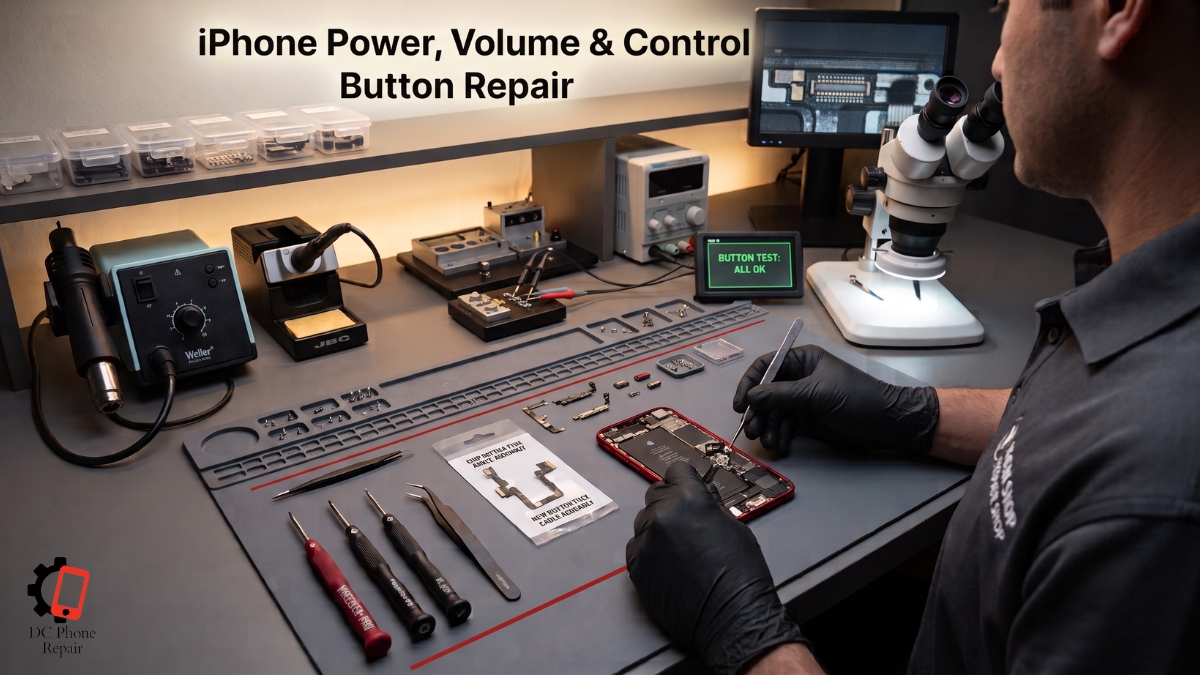
A damaged physical button can turn a reliable phone into a daily inconvenience. The device may still charge, display notifications, connect to the internet, and run applications, yet one basic action suddenly takes several attempts. You may have to press harder than normal, push the button at an angle, use an on-screen workaround, or repeatedly remove the case just to make the control respond. In other situations, the button may remain stuck, activate without being touched, or produce a normal click while the phone ignores the input completely.
These problems are easy to underestimate because the affected part is small. The visible button is only the outer contact point. Underneath it may be a bracket, internal actuator, flex cable, connector, contact surface, seal, and board-controlled circuit that converts physical pressure into a command. Damage to any part of that path can create similar symptoms. A button that feels soft may have a mechanical problem, while a button that clicks correctly but does nothing may have an electrical or connection-related fault.
iPhone Air Home Button Repair starts with identifying which part of the control system has failed. Replacing the visible button cap will not correct a torn internal cable. Replacing an internal component may be unnecessary when the real issue is debris around the opening, pressure from a case, software behavior, or a misaligned external part. A proper diagnostic separates those possibilities before the customer pays for repair work.
This page explains how DC Phone Repair approaches iPhone Air Home Button Repair in Barry Farm DC. It covers the symptoms that suggest a hardware fault, common causes, the diagnostic and repair process, booking, replacement-part options, expected turnaround, warranty coverage, data safety, and the tradeoffs between local repair, manufacturer service, mail-in repair, do-it-yourself work, and an unusually low-cost quote.
The purpose of the repair is not simply to make the button move again. The affected control should respond consistently, feel correctly aligned, avoid activating on its own, and perform its intended function without excessive pressure. The technician must also protect the nearby display, battery, frame, seals, cables, and internal connectors while reaching the damaged part.
What Is iPhone Air Home Button Repair?
iPhone Air Home Button Repair is the process of diagnosing and correcting the physical-control problem described by the service name. Depending on the device and the exact control involved, the repair may require cleaning the opening, repositioning an external part, replacing a button cap, repairing an internal bracket, replacing a flex cable, restoring a connector, correcting frame pressure, or addressing another fault in the input path.
The visible control and the internal switch are not always the same part. Pressing the outside button transfers force to an internal mechanism. That mechanism then activates an electrical contact or sends a signal through a cable to the device. If the external part is bent or blocked, the press may never reach the internal switch. If the internal switch or cable is damaged, the outer button may still click normally even though the phone does not respond.
This distinction explains why button problems can feel very different. One control may become stiff and require unusual pressure. Another may feel loose and move from side to side. A third may remain physically normal but respond only once every several presses. Some controls become stuck in the pressed position, which can cause repeated commands, unexpected system behavior, or difficulty starting and using the device.
Common causes include impact, frame deformation, pocket debris, moisture, worn contact surfaces, repeated heavy pressure, internal cable damage, corrosion, a swollen component pressing from inside the device, and previous repair work. A case that fits too tightly can also hold a control partially pressed or prevent it from moving through its normal range.
A drop does not need to crack the screen to damage a button assembly. Impact along the frame can shift the external cap, deform the opening, loosen a bracket, or tear a delicate internal cable. The device may appear undamaged from the front while the affected control becomes difficult to press later that day.
Moisture can create a different pattern. The button may initially work after exposure, then become intermittent as corrosion develops around contacts or connectors. Drying the outside does not remove moisture that has already reached an internal component. In these cases, replacing only the visible part may not resolve the electrical damage underneath.
Previous repair work can also affect button operation. A cable may be pinched during reassembly, a bracket may be installed incorrectly, adhesive may interfere with movement, or frame pressure may change after another component is replaced. The button problem may appear immediately or develop gradually as the misaligned part wears.
Not every unresponsive control needs hardware replacement. Software settings may change what a button does. An accessibility feature may alter the required press duration. The operating system may stop responding temporarily. A protective case may block the normal movement. Dirt around the edge may prevent full travel. A diagnostic should rule out these simpler causes where appropriate.
DC Phone Repair's technicians in Barry Farm DC test the affected control repeatedly and observe both its physical movement and the device's response. The technician checks whether the problem occurs with the case removed, whether the control feels different from nearby controls, whether it activates from every angle, and whether software-based commands still perform the same function.
The technician may also inspect the frame for dents, gaps, separation, or signs of internal pressure. A button that has become difficult to press can occasionally be a symptom of a wider structural problem. Treating the control alone without identifying that pressure may lead to another failure.
The correct repair is therefore based on the entire input path. DC Phone Repair confirms whether iPhone Air Home Button Repair involves an external mechanical problem, an internal switch, a cable, a connector, contamination, frame damage, software behavior, or a combination of issues. The customer receives that explanation before deciding whether to proceed.
Signs Your Device Needs iPhone Air Home Button Repair
A control does not need to be completely dead before it requires attention. Small changes in feel or response can indicate that the mechanism is wearing, blocked, misaligned, or losing electrical contact. The following symptoms may suggest that the device needs iPhone Air Home Button Repair:
- The affected button does not respond at all
- The button responds only after several presses
- More pressure than normal is required
- The control works only when pressed at a certain angle
- The button feels loose, wobbly, or uneven
- The control feels stiff and has very little movement
- The button no longer produces a normal tactile click
- The control clicks normally but the device does not react
- The button remains stuck in the pressed position
- The device performs the command without the button being touched
- A single press is sometimes registered as several presses
- The control works with the case removed but fails when the case is installed
- The problem began after a drop or impact near the frame
- The issue appeared after liquid or heavy moisture exposure
- The control became unreliable after another repair
- The surrounding frame looks dented, bent, or separated
- The external button cap appears damaged, missing, or misaligned
- The device responds through an on-screen alternative but not through the physical control
- The button works when the phone is cold but fails after it becomes warm
- The control stops responding when the device is held or squeezed in a certain way
- The affected function activates continuously or repeatedly
- The button feels different from the same control before the damage occurred
These symptoms help narrow the problem, but they do not identify the failed part by themselves. A button that requires extra pressure may be blocked by debris, misaligned after impact, or worn internally. A control that activates by itself may be stuck mechanically, compressed by a tight case, affected by frame deformation, or shorting through a damaged flex cable.
The relationship between physical feel and electronic response is especially useful. If the button has lost its click, the problem may be mechanical. If it clicks normally but the device never reacts, the fault may be deeper in the electrical path. If the response changes when the phone is moved, pressed, or warmed, the technician may suspect a loose connection, cable damage, or pressure from another component.
Customers should also pay attention to timing. A problem that started immediately after a drop points toward impact or alignment damage. A fault that developed slowly may involve wear, debris, or gradual cable failure. A control that became unreliable after liquid exposure may be affected by corrosion even when the outside looks dry.
A case can create surprisingly convincing symptoms. If the case presses too tightly around the frame, the button may remain partially engaged or fail to complete its normal movement. Testing the device without the case is a useful first step, but customers should avoid forcing a button that remains stuck.
Software-related behavior can sometimes resemble a physical fault. The system may react slowly, an application may freeze, or a setting may change the expected command. Testing the same control in several parts of the operating system helps determine whether the problem is limited to software or follows the physical input everywhere.
DC Phone Repair's technicians in Barry Farm DC reproduce the issue before recommending iPhone Air Home Button Repair. The technician checks movement, alignment, response, surrounding frame condition, and any available on-screen alternative. This prevents a functional component from being replaced because of a case, temporary software problem, or unrelated internal fault.
Why Barry Farm DC Customers Choose DC Phone Repair for iPhone Air Home Button Repair
A failing button can interfere with routine tasks throughout the day. The affected control may be needed to wake the device, silence an alert, confirm an action, adjust a function, restart the phone, capture something quickly, or recover from a frozen screen. On-screen workarounds may help temporarily, but they are not always available when the device is locked, restarting, or behaving unexpectedly.
Customers in Barry Farm DC often prefer a local diagnostic because button problems are easier to demonstrate in person than describe through a shipping form. Terms such as stiff, loose, delayed, stuck, or intermittent can mean different things. A technician can physically press the control, compare its feel, remove the case, inspect the frame, and watch how the device responds.
Local service also avoids the uncertainty of selecting the wrong mail-in category. A customer may assume that the external button needs replacement, while the diagnostic shows that the internal cable is damaged. Another customer may expect a major repair when cleaning and alignment resolve the problem. An in-person evaluation provides that distinction before the device leaves the customer's control for several days.
DC Phone Repair handles iPhone Air Home Button Repair locally for customers in Barry Farm DC. Walk-in availability allows many customers to begin with a diagnostic without arranging shipping or waiting for a remote facility to receive the phone. An appointment can still be useful when the customer has a strict schedule or wants the team to check likely part availability before arrival.
Local accountability is another practical advantage. Customers can ask what failed, whether the external and internal parts were both inspected, what replacement option is being used, how the control will be tested, and what the warranty covers. If the repaired control later becomes unreliable without new damage, the customer can return to the same shop with the repair record.
Manufacturer service can be a strong option for a device covered by an applicable protection program. The tradeoff may involve shipping, appointment availability, preparation requirements, replacement policies, and time without the device. Some manufacturer procedures may replace a larger assembly rather than the smallest damaged part.
Big-box repair counters can be convenient, although customers should ask whether the diagnosis and repair occur at the same location. Some jobs may be sent elsewhere, which can affect communication and turnaround. The person accepting the device may not be the technician who inspects the internal mechanism.
DC Phone Repair's technicians in Barry Farm DC focus on transparent diagnosis, part quality, and functional testing. A quote is provided before work begins. Many standard button-related repairs can be completed the same day when the required part is available and no additional structural or liquid damage is found.
More complicated cases may require additional time. Frame deformation, corrosion, board-level damage, multiple failed controls, a swollen internal component, or damage from an earlier repair can change the scope. The technician explains these conditions after inspection rather than applying the same promise to every device.
Our Repair Process
DC Phone Repair follows a five-stage process for iPhone Air Home Button Repair. Each stage is designed to confirm the fault, avoid unnecessary replacement, protect the device during disassembly, and verify that the affected control works consistently before pickup.
Diagnostic
The diagnostic begins with the customer's description of the problem. The technician asks when the issue started, whether the control is completely unresponsive or intermittent, whether the device was dropped or exposed to liquid, and whether the symptom changes with the case removed.
The affected control is then tested repeatedly. The technician checks the amount of movement, tactile feedback, alignment, pressure required, and consistency from different positions. A control that responds only when pressed at one edge may have a different fault from one that has no physical movement at all.
The device's electronic response is checked at the same time. The technician confirms whether a press is registered, delayed, repeated, or ignored. Where possible, an on-screen alternative may be used to verify that the intended function still works through software. If the software command works normally but the physical control does not, the fault is more likely to be in the physical input path.
The case and external accessories are removed during testing. The surrounding frame is inspected for dents, bending, gaps, impact marks, and evidence that the button opening has shifted. The technician also checks whether the external cap is missing, loose, pushed inward, or rubbing against the frame.
Software-related causes are considered where appropriate. Settings that affect press duration, repeated input, accessibility behavior, or control mapping may be reviewed. A restart or basic software test may help distinguish a system problem from a hardware failure.
If the issue cannot be confirmed externally, the technician explains whether internal inspection is needed. Opening the device may reveal a torn flex cable, displaced bracket, loose connector, corrosion, adhesive interference, missing hardware, or pressure from another component.
Quote
After the diagnostic, the customer receives an explanation of the likely failure and the recommended repair. The quote reflects the actual device, the affected control, the damaged part, the required labor, the available replacement option, and any additional condition found during inspection.
No single price applies to every request for iPhone Air Home Button Repair. Cleaning and alignment are different from replacing an internal flex assembly. Frame correction is different from restoring a connector. A device with liquid-related corrosion may require more work than one with a worn mechanical contact.
The technician explains whether the repair is expected to restore the external feel, the electronic response, or both. If the frame or opening has been physically deformed, the customer is told whether a replacement part can sit correctly without additional structural work.
Part availability and expected turnaround are confirmed before the customer approves the job. No repair begins without authorization.
If further damage is discovered after disassembly, DC Phone Repair contacts the customer before expanding the work. A hidden tear, corrosion, missing bracket, damaged connector, or pressure from another component can change the original plan. The customer receives the new information and decides whether to proceed.
Repair
Once the quote is approved, the device is powered down and prepared for service. Opening procedures vary by device, but the technician works carefully around the display, battery, internal seals, cameras, sensors, cables, and other components near the affected control.
If debris is preventing normal movement, the opening and surrounding area are cleaned with tools suited to small mechanical parts. Sharp household tools, excessive liquid, or aggressive scraping can damage the cap, frame, seal, or internal switch. Professional cleaning aims to remove the obstruction without pushing it deeper.
If the external button cap is damaged or misaligned, the technician inspects the opening and internal actuator before installing or repositioning the part. Replacing the cap alone is not useful if the internal mechanism beneath it has failed.
When an internal flex assembly or switch requires replacement, the technician disconnects the damaged component, inspects the connector and surrounding area, and installs the compatible replacement. Brackets, screws, seals, and alignment points are restored according to the device's design.
A loose connector may be reseated when the component remains functional. Torn material, corrosion, or damaged contacts may require replacement or more advanced repair. If the fault extends to a board-level connection, the customer is informed that the service is more complex than a standard modular replacement.
Frame pressure must also be considered. A new component installed into a bent opening may remain stiff or fail again. Where practical, the technician corrects minor alignment issues or explains when wider frame damage limits the expected result.
Any adhesive or seal disturbed during disassembly is restored as closely as practical. Customers should understand that opening a previously sealed device can affect its original factory resistance to water and dust. The technician can explain the limitations that apply after repair.
Quality Check
The repaired control is tested repeatedly before the device is returned. The technician checks movement, tactile feedback, alignment, pressure, electronic response, and consistency. The button should not require unusual force, remain stuck, or activate without being touched.
Testing includes the function that originally failed. If the customer reported intermittent response, the technician performs repeated presses rather than checking the control once. If the problem appeared only while holding or moving the phone, the device may be tested in several positions.
The surrounding frame is inspected for gaps, rubbing, uneven placement, or pressure against the replacement part. Nearby controls and functions may also be checked when the repair required disassembly around them.
If the button moves normally but the device still ignores the command, the repair is not treated as complete. The technician rechecks the connector, flex cable, replacement component, software response, and related circuitry.
The quality check aims to reproduce real use. A control that works once on the bench but fails during repeated operation has not been fully repaired. Consistency matters as much as initial response.
Pickup
After the device passes the quality check, the customer is contacted for pickup. The repair notes identify what was cleaned, adjusted, reconnected, replaced, or corrected. The applicable warranty is explained at the same time.
Customers are encouraged to test the affected control before leaving. Pressing it several times and checking the intended function confirms that the repair addresses the original complaint.
Most standard iPhone Air Home Button Repair jobs can often be completed the same day when the required component is available. Repairs involving corrosion, frame damage, uncommon parts, internal pressure, previous repair problems, or board-level faults may take longer.
The customer receives the expected completion time after the diagnostic. If the scope changes during repair, the team provides an updated estimate before proceeding with additional work.
How Booking Works
Customers can arrange iPhone Air Home Button Repair by calling DC Phone Repair, requesting a consultation, or visiting the shop during business hours. Walk-in diagnostics may be available, while booking ahead can help customers who have a limited schedule or need the team to check part availability.
When contacting the shop, describe how the button behaves. Useful details include whether it is stuck, loose, stiff, unresponsive, overly sensitive, or intermittent. Mention whether it clicks normally, whether the problem changes with the case removed, and whether an on-screen alternative still performs the same function.
The repair team also needs to know whether the issue began after a drop, liquid exposure, software update, case change, or previous repair. These details help the technician prepare for likely mechanical, connection, or corrosion-related causes.
Bring the device itself and remove any case or accessory that covers the affected area. If the button works only with a particular case installed or removed, bring that case so the technician can reproduce the interaction.
A recent backup is recommended before hardware service. iPhone Air Home Button Repair normally does not require erasing the device, but a backup protects important information if the phone has hidden impact damage, corrosion, power problems, or another fault unrelated to the control.
The technician may request access to settings and the function controlled by the affected button during diagnosis and final testing. Sharing the passcode is optional. Customers who prefer not to provide it can unlock the phone during check-in or test certain functions themselves at pickup.
The initial visit includes a symptom review, physical inspection, functional testing, and a preliminary determination of the failed area. If internal inspection is necessary, the technician explains why before opening the device.
After the diagnosis, the customer receives a quote and expected turnaround. There is no obligation to approve the repair. If the customer proceeds, the team confirms the available replacement option and contacts the customer when the phone is ready.
If additional damage appears during disassembly, the customer receives an updated explanation before any new work is completed. This prevents surprise charges and gives the customer control over the repair decision.
Why Choose DC Phone Repair
A customer with a failing physical control usually has several choices. The phone can be used with an on-screen workaround, cleaned at home, repaired with a do-it-yourself kit, sent to a manufacturer, mailed to a remote provider, or taken to a local shop. Each option has practical tradeoffs.
An on-screen alternative can be useful temporarily. It may allow the customer to perform the basic function without the damaged button. The limitation is that software controls are not always available while the device is locked, restarting, frozen, or powered down. A stuck physical control may also continue sending unintended commands even when an on-screen workaround is enabled.
Basic exterior cleaning may help when debris is visible around the opening. Customers should avoid pins, blades, excessive liquid, strong compressed air, and aggressive scraping. These methods can scratch the frame, tear a seal, push debris inward, or damage the mechanical contact.
Do-it-yourself replacement kits can reduce labor cost for someone experienced with electronics. The risks are significant because button assemblies are often connected by thin cables and positioned close to other sensitive parts. Opening the phone may damage the display, puncture the battery, tear a nearby cable, disturb seals, or create alignment problems.
Button repairs can also require more disassembly than the size of the part suggests. A small external control may connect to an internal assembly routed behind other components. A repair video may make the process appear straightforward while leaving out the difficulty of adhesive removal, screw organization, cable routing, and final alignment.
Manufacturer service may be appropriate for a device covered by a protection plan or for a customer who prefers standardized manufacturer procedures. Customers should consider appointment availability, shipping time, backup requirements, replacement policies, and whether the manufacturer repairs the individual component or replaces a larger assembly.
Mail-in repair providers can serve customers who do not have a qualified local shop nearby. Before sending the phone, customers should review shipping insurance, tracking, diagnostic fees, turnaround, warranty terms, and the process used when the actual failure differs from the selected service.
An unusually low-cost local quote may be attractive, but the customer should ask what is included. Diagnosis, part quality, frame inspection, internal cleaning, adhesive restoration, functional testing, and warranty coverage all affect the finished repair.
A replacement component may work briefly but remain stiff, loose, or intermittent if the frame is not inspected or the assembly is installed under pressure. A complete repair addresses both the part and the reason it failed.
DC Phone Repair approaches iPhone Air Home Button Repair with diagnosis before replacement. The technician checks the physical feel, electronic response, case interaction, frame condition, internal connection, and repair history. The customer receives a quote before work begins and can ask questions directly.
The repaired control is tested through repeated use before pickup. This matters because intermittent button faults may not appear during a single press. DC Phone Repair checks for consistency, alignment, pressure, unwanted activation, and the intended function.
Devices & Issues We Handle
Controls That No Longer Respond
A completely unresponsive control may have a failed internal switch, damaged cable, disconnected connector, software-related issue, or physical obstruction that prevents the press from reaching the mechanism. The external button may still look normal.
A field technician may depend on the phone throughout the day and find that a basic command can be performed only through an on-screen menu. That workaround may help temporarily, but it does not reveal whether the internal component is disconnected, worn, or damaged by impact.
DC Phone Repair's technicians in Barry Farm DC compare the physical press with the device's electronic response. An on-screen alternative may be used to verify that the intended function still works through software. This helps determine whether iPhone Air Home Button Repair should focus on the physical input path.
Stiff, Jammed, or Sunken Controls
A control that has lost normal movement may be blocked by debris, misaligned after impact, pressed inward by frame damage, or affected by an internal bracket. Forcing it repeatedly can worsen the damage.
A warehouse supervisor who uses a phone around dust and packaging material may notice that the button has gradually become harder to press. The cause may be material packed around the opening rather than a failed electrical component. In another device, the same symptom may be caused by a bent frame.
The diagnostic for iPhone Air Home Button Repair checks the opening, external cap, travel, alignment, and surrounding frame. Cleaning may be enough when the mechanism is intact, while damaged internal parts require a different repair.
Loose or Inconsistent Controls
A loose button may move sideways, rattle, or respond only when pressed at one edge. This can happen when the external cap, internal bracket, actuator, or supporting frame has worn or shifted.
A photographer using a phone during an event may find that the affected control works from one angle but fails during quick use. The inconsistency can cause missed actions even though the button is not completely broken.
DC Phone Repair tests the control repeatedly from normal positions. The technician also checks whether the frame or bracket allows the part to move away from its intended contact point.
Intermittent Input and Repeated Activation
Some button faults appear only occasionally. The control may work after a restart, fail when the phone becomes warm, or register several commands from one press. Intermittent symptoms can point to a damaged cable, loose connector, moisture, pressure, or worn contact.
A healthcare worker may keep the phone in a fitted protective case and notice that the control activates while the device is in a pocket. The case may be applying constant pressure, or the internal switch may be shorting without a full press.
The diagnostic for iPhone Air Home Button Repair includes testing with accessories removed and observing the response during repeated operation. A control that activates on its own should be inspected rather than treated only with a software workaround.
Damage After Impact, Moisture, or Earlier Repair
Button faults often appear after an event that affects more than the visible control. A drop can deform the frame, liquid can corrode the connector, and a previous repair can pinch a flex cable or leave a bracket misaligned.
A small business owner may have a display replaced elsewhere and later notice that the nearby button has become difficult to use. The control itself may still be functional, but pressure from reassembly, a misplaced bracket, or a cable routed incorrectly can affect its movement.
DC Phone Repair's technicians in Barry Farm DC consider the repair history and inspect the surrounding structure. The goal is to determine whether iPhone Air Home Button Repair requires a new part, correction of earlier work, or additional repair to the frame or connection.
Pricing & Turnaround
The exact cost of iPhone Air Home Button Repair depends on the device, the affected control, the failed component, the condition of the frame, part availability, and whether the repair involves cleaning, adjustment, cable replacement, connector work, corrosion, or structural damage.
DC Phone Repair provides a diagnostic and quote before beginning the repair. No specific price is assumed from the service name alone. Two devices with similar symptoms may require very different work.
| Service Stage | Typical Turnaround | Pricing |
|---|---|---|
| Initial diagnostic | Usually 15–30 minutes | Request diagnostic |
| Cleaning or minor adjustment related to iPhone Air Home Button Repair | Often completed during the same visit | Call or request an exact quote |
| iPhone Air Home Button Repair | Many standard repairs can be completed the same day | Get a quote for the specific repair |
| Repair requiring uncommon components | Confirmed after part availability is checked | Call for device-specific pricing |
| Frame, corrosion, or board-related repair | Varies according to the damage found | Request a diagnostic and repair quote |
Many standard repairs can be completed the same day when the required part is available and the surrounding frame is undamaged. A straightforward internal component replacement may take a few hours, while corrosion, structural damage, previous repair problems, or board-level faults may require additional time.
Customers who need the phone back by a particular deadline should mention that when booking. The team can check likely part availability in advance, although the final turnaround is confirmed after inspection.
A preliminary quote given over the phone depends on the accuracy of the device and symptom information provided. The final quote is based on the inspected phone because a stiff, loose, or unresponsive button can involve different internal parts.
If additional damage is discovered during disassembly, the customer is contacted before the price or repair scope changes. This allows the customer to make an informed decision rather than receiving an unexpected charge at pickup.
Parts & Warranty
Replacement-part options for iPhone Air Home Button Repair depend on the device, the affected control, and the component that has failed. Some repairs may have a genuine manufacturer part available. Others may use a high-quality aftermarket component selected for compatibility, fit, and consistent operation.
Genuine parts are produced to the original specification and generally offer the closest match to the factory component. Availability may vary according to the device, age, supply channel, and exact repair.
High-quality aftermarket parts can provide a practical alternative when a genuine component is unavailable or when the customer prefers another option. The technician explains the available choice before the repair is approved.
Part quality is only one part of the result. Alignment, cable routing, bracket placement, connector condition, frame pressure, seals, and testing all affect how the control feels and responds. A compatible component can still perform poorly if it is installed into a bent opening or placed under pressure.
DC Phone Repair inspects the replacement before and after installation. The affected control is tested repeatedly for movement, response, tactile feel, unwanted activation, and the intended function.
Completed repairs include written warranty information. The applicable warranty period is [WARRANTY_LENGTH]. The warranty covers defects in the installed part and problems caused by repair workmanship during that period.
The warranty does not cover a new drop, new impact, liquid exposure after repair, misuse, forced operation, tampering, frame damage caused later, or work performed by another provider. If the repaired control develops a fault without new damage, the customer should return with the original repair documentation.
The technician explains the warranty duration, covered component, exclusions, and inspection process at pickup. Customers should keep the receipt because it connects the device to the service record.
What Happens to Your Data
iPhone Air Home Button Repair normally focuses on the physical input hardware and does not require deleting photos, messages, applications, contacts, or account information. The phone's storage is generally not replaced or reformatted during a standard button repair.
A current backup is still recommended before any hardware service. This is a standard precaution, particularly when the device has impact damage, corrosion, power problems, frame deformation, or a history of previous repair.
The backup recommendation does not mean that data loss is expected during iPhone Air Home Button Repair. It protects the customer if the phone has an unrelated internal fault that becomes apparent during service.
Customers can back up through the device's supported cloud service or a compatible computer. Important photos, contacts, documents, account recovery information, and other files should be confirmed before the phone is left for repair.
The technician does not need to browse personal content to replace a physical control component. Functional testing may require access to settings, the lock screen, or the system function connected to the affected button.
Providing a passcode is optional. It can help the technician complete the diagnostic and quality check without requiring the customer to remain present. Customers who prefer not to provide it can unlock the device during check-in or verify some functions themselves at pickup.
DC Phone Repair uses the device only for testing reasonably related to the repair. Passcodes are not intended to be recorded or retained after the service.
If the device cannot start because the affected control is part of the startup process, the technician may need to use diagnostic methods that do not depend on normal operation. The team will explain whether the button problem can be repaired independently or whether the phone also has a power, battery, display, or board-related fault.
Get Started
The first step toward iPhone Air Home Button Repair is confirming whether the fault is mechanical, electrical, structural, software-related, or caused by an accessory. Similar symptoms can require different repairs, and the visible button is not always the failed part.
DC Phone Repair's technicians in Barry Farm DC inspect the control, remove accessory interference, test the device's response, and examine the surrounding frame. The customer receives an explanation and quote before work begins.
Before visiting, create a current backup where possible. Remove the case and note whether the button responds differently without it. Mention any recent drop, moisture exposure, software change, internal repair, or change in physical feel.
Customers should avoid forcing a jammed or sunken control. Repeated heavy pressure can damage the internal switch, cable, bracket, or surrounding frame. An on-screen alternative may provide temporary access until the device can be inspected.
Many standard repairs can be completed the same day when the required component is available. More complicated damage is explained before the customer approves additional work.
Customers who prefer email can contact support@dcphonerepair.com. Include the device model, a description of how the button behaves, when the problem began, and whether the phone was dropped, exposed to liquid, or repaired previously.
FAQs
How long does iPhone Air Home Button Repair usually take?
Many standard iPhone Air Home Button Repair jobs can be completed the same day when the required part is available and no additional damage is found. The initial diagnostic usually takes about 15–30 minutes, after which the technician provides a more specific completion estimate.
Frame damage, corrosion, uncommon parts, internal cable damage, earlier repair problems, or board-level faults can extend the turnaround. The customer is informed if the expected completion time changes after inspection.
How much does iPhone Air Home Button Repair cost?
The exact cost depends on the device, the affected control, the failed component, part availability, and the condition of the surrounding frame. DC Phone Repair provides a quote after the diagnostic and before beginning the repair.
Cleaning, external-cap repair, flex-cable replacement, connector work, and frame correction do not require the same labor or parts. Customers can call for preliminary guidance, but the final quote is based on the inspected device.
Can debris make a button stop working?
Yes, debris can restrict the movement of an external control and prevent it from reaching the internal switch correctly. Cleaning may restore normal operation when the internal mechanism remains undamaged.
The technician inspects the opening before recommending replacement. Sharp tools or aggressive scraping should be avoided because they can push debris deeper or damage the control and surrounding frame.
Why does the button click but not perform the command?
A normal click with no electronic response may indicate a damaged internal switch, flex cable, connector, contact, or related circuit. The external mechanism can still move even when the signal no longer reaches the device.
DC Phone Repair tests both the physical movement and the software response. This helps determine whether iPhone Air Home Button Repair requires an internal component repair rather than work on the visible cap.
Can I keep using an on-screen alternative instead of repairing the button?
An on-screen alternative can provide a temporary workaround, but it does not repair the damaged physical control. Software controls may also be unavailable while the device is locked, restarting, frozen, or powered down.
A stuck or shorting button can continue causing unintended commands even when an on-screen alternative is enabled. An inspection is recommended when the control activates by itself or remains physically jammed.
Will I lose my photos or messages during iPhone Air Home Button Repair?
A standard button repair does not normally erase photos, messages, applications, or contacts. The work focuses on the physical input component and its connection rather than the phone's storage.
A current backup is still recommended before any hardware repair. This protects the customer if the phone has hidden impact damage, corrosion, or another fault unrelated to the button service.
Do I need an appointment for iPhone Air Home Button Repair?
An appointment is not always required, and walk-in diagnostics may be available during business hours. Booking ahead is helpful when the customer has a limited schedule or wants the team to check likely part availability before arrival.
Provide the device model and a clear description of how the control behaves when booking. The final recommendation is made after the device has been inspected and tested.
Does iPhone Air Home Button Repair include a warranty?
Yes, completed repairs include written warranty information for the installed part and repair workmanship. The applicable warranty period is [WARRANTY_LENGTH].
The warranty does not cover new impact, new liquid exposure, misuse, forced operation, tampering, later frame damage, or work performed by another provider. Customers should retain the original repair documentation and return the device for inspection if a covered fault develops.
DC Phone Repair
2704 Marion Barry Ave SE,
Washington DC 20020, United States
(202) 478-4799
support@dcphonerepair.com
https://dcphonerepair.com/