DC Phone Repair
iPhone 13 SIM Card Tray Repair in Woodland DC
An advanced internal fault can make a phone behave unpredictably even when there is no obvious crack, missing part, or visible sign of damage. The device may restart without warning, lose one specific function, stop recognizing an internal component, vibrate incorrectly, fail to connect consistently, or remain completely unresponsive despite a working screen and battery. In other cases, the phone may continue operating but develop a fault that returns every few hours or only appears under certain conditions.
These problems are difficult to diagnose from symptoms alone because several internal parts can produce similar behavior. A failed component may be the immediate cause, but a damaged connector, torn cable, corroded contact, unstable power line, board-level circuit, frame problem, or previous repair can create the same outward result. Replacing the most obvious part without identifying the complete fault may waste time and leave the original problem unresolved.
iPhone 13 SIM Card Tray Repair begins with controlled testing. The technician must determine whether the issue is mechanical, electrical, connection-related, software-controlled, or located at board level. The repair may involve a replaceable internal assembly, a delicate cable, a physical opening, an electrical contact, a small motorized component, a damaged socket, or circuitry that cannot be evaluated through exterior inspection alone.
The condition of the original component also matters. A part may be physically damaged but still repairable. A connector may look intact while one internal contact has failed. A device may stop responding because corrosion is interrupting communication rather than because the main component has permanently failed. Advanced repair work is therefore based on evidence gathered during diagnosis, not on the repair name alone.
This page explains how DC Phone Repair approaches iPhone 13 SIM Card Tray Repair in Woodland DC. It covers common symptoms, internal diagnostics, board and component testing, repair limitations, booking, quote-based pricing, turnaround, replacement-part options, warranty coverage, data safety, and the differences between professional service, manufacturer support, mail-in specialists, and do-it-yourself attempts.
The goal is not simply to make the device power on once or restore one function briefly. A successful repair should address the confirmed cause, remain stable during repeated testing, and avoid creating new problems in nearby components. When full restoration is not practical, the customer should receive an honest explanation of the remaining options before additional money is spent.
What Is iPhone 13 SIM Card Tray Repair?
iPhone 13 SIM Card Tray Repair is the process of diagnosing and repairing the internal or advanced fault described by the service name. Depending on the exact device and issue, the repair may involve an individual component, an internal cable, a socket, a removable external piece connected to an internal mechanism, a vibration-producing assembly, a damaged connector, or a fault located on the device's main board.
Some internal repairs are modular. A damaged assembly can be disconnected and replaced with a compatible part after the technician confirms that the surrounding connector and circuit remain functional. Other faults require component-level work because the damaged area is attached directly to the board or because replacing the entire board would affect stored data, device identity, security functions, or overall repair cost.
The device's main board distributes power and communication between many systems. A fault in one small area can affect charging, display behavior, sound, cameras, buttons, sensors, vibration, network communication, startup, or data access. The visible symptom does not always point directly to the damaged line or component.
A phone that restarts repeatedly may have an unstable power path, damaged internal communication, corrosion, a failing connected component, or software behavior. A single function that stops working may be caused by the component itself, but it can also result from a broken flex cable, damaged contact, missing board signal, or poor connection after earlier repair work.
Physical internal parts can create similarly confusing symptoms. A removable piece may no longer fit because the external part is bent, the internal opening is damaged, or material is lodged inside. A vibration-related fault may come from the motorized component, its connector, a mounting problem, software settings, or a board-level control signal.
Common causes include impact, liquid exposure, corrosion, repeated mechanical stress, damaged connectors, manufacturing defects, heat, battery problems, frame deformation, improper disassembly, and earlier repairs. Some faults appear immediately. Others develop slowly as a weakened cable or corroded contact becomes less reliable.
Impact can damage an internal component without leaving a visible crack. A drop may loosen a connector, break a solder joint, deform a socket, or shift a mounted assembly. The phone may work normally for a period before movement, heat, or vibration causes the connection to fail again.
Liquid exposure is another common cause of advanced internal faults. Moisture and residue can affect a connector, cable, board contact, or small component. The phone may appear dry while corrosion continues underneath a shield or around a circuit. Replacing one failed part without cleaning and inspecting the affected area may result in another failure.
Heat can come from heavy use, charging problems, battery damage, poor internal contact, or a shorted component. A device that becomes unusually hot near one internal area should be inspected. Continued operation can place additional stress on the battery and surrounding circuitry.
Previous repair history matters because advanced faults sometimes begin after another component has been replaced. A cable can be torn, a connector can be damaged, a screw can be installed in the wrong position, a bracket can be left loose, or pressure can be placed on the board during reassembly. The current symptom may not appear until days or weeks later.
Software should also be considered. An unavailable function may be disabled by settings, an application, an update, or a temporary operating-system problem. DC Phone Repair's technicians in Woodland DC rule out reasonable software causes before recommending internal hardware work when the symptom allows that testing.
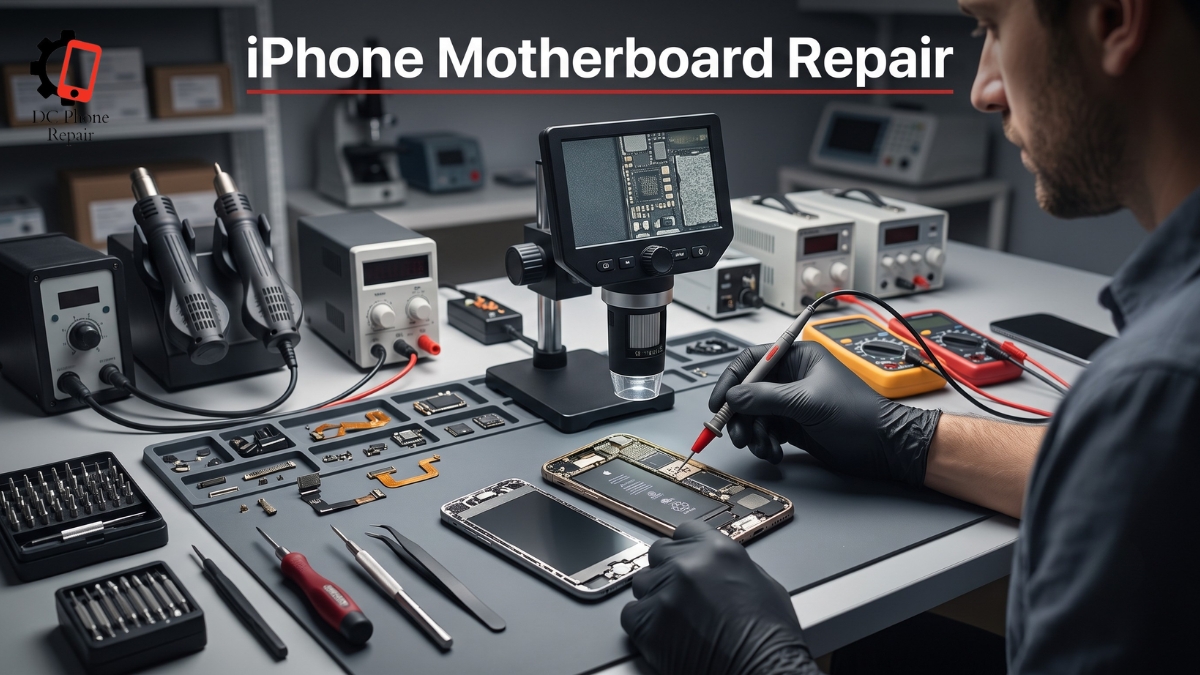
Professional diagnosis may involve visual inspection, controlled power testing, functional comparison, connector examination, known-good test components, magnification, continuity checks, and board-level measurement. The exact methods depend on iPhone 13 SIM Card Tray Repair and the condition of the device.
A technician may begin by testing the affected function through normal use. If the problem is intermittent, the phone may be tested while moving, warming, charging, or switching between operating conditions. Reproducing the fault is important because a device that works normally during intake may still have an unstable connection.
Internal inspection allows the technician to look for corrosion, impact marks, damaged connectors, torn cables, missing hardware, loose shielding, contamination, and earlier repair work. The suspected component can then be isolated from related systems.
Board-level faults require careful diagnosis. Replacing the entire main board may not be a suitable answer because the original board may contain the customer's data and device-specific information. Repairing the damaged area of the original board can sometimes preserve those functions, although feasibility depends on the extent and location of the damage.
Not every advanced fault is repairable. Severe board damage, destroyed storage communication, missing pads, extensive corrosion, heat damage, or a broken component with no compatible replacement may limit the result. A responsible diagnostic explains these limitations before the customer approves extensive work.
iPhone 13 SIM Card Tray Repair is therefore a condition-based service. The technician confirms what has failed, which original parts remain usable, what replacement or repair method is available, and how the result will be tested. The final quote follows that diagnosis rather than a general assumption based only on the service phrase.
Signs Your Device Needs iPhone 13 SIM Card Tray Repair
Advanced internal problems can affect one function or several systems at once. Some symptoms remain constant, while others appear only during charging, movement, heat, network use, or startup. The following signs may indicate that the device needs iPhone 13 SIM Card Tray Repair:
- The device does not power on even after the battery and display have been checked
- The phone restarts repeatedly or shuts down without warning
- The device remains stuck during startup
- One internal function stops working while the rest of the phone appears normal
- The affected function works only after restarting the device
- The problem returns after a temporary software reset
- The phone becomes unusually warm near one internal area
- The device loses power when moved, pressed, or held at a certain angle
- The fault began after a drop even though the exterior looks undamaged
- The problem appeared after liquid or heavy moisture exposure
- A replacement component does not work even though it is compatible
- The device reports that an internal component is unavailable
- A removable part no longer fits, seats, releases, or aligns correctly
- The phone does not recognize an inserted or connected item consistently
- The device vibrates weakly, irregularly, continuously, or not at all
- Internal rattling can be heard after impact or previous repair
- The affected function changes when the device warms up
- The phone works while open but fails after full reassembly
- The device shows signs of corrosion around an internal connector
- One connector or socket appears bent, loose, or damaged
- The problem began immediately after another repair
- The phone has unstable charging, display, sound, or network behavior at the same time
- The battery drains rapidly even when the device is not being used heavily
- The phone becomes unresponsive under normal load
- A function activates without being requested
- The device loses communication with an internal assembly intermittently
- The phone has visible board or cable damage from a previous repair attempt
- The device powers on but cannot access normal system functions
- The phone works only when connected to external power
- Several replacement parts have already been tried without solving the problem
These signs do not all point to the same repair. A phone that does not power on may have a battery, display, charging, connection, or board-level fault. Repeated restarts can come from software, unstable power, damaged internal communication, a failing connected component, or corrosion.
A single-function failure may seem easier to diagnose, but the component itself is not always the cause. The signal may pass through a cable, connector, board circuit, or software control before reaching the affected part. Testing only the final component can miss the damaged section earlier in the path.
Intermittent symptoms are especially important. A device that changes behavior when moved may have a loose connection or fractured cable. A problem that appears after the phone warms up may involve an unstable solder joint, component, or power line. A function that works before final reassembly but fails after closing the device may be affected by pressure or cable positioning.
Customers should note the sequence of events before the problem began. A recent drop, repair, battery replacement, screen replacement, frame repair, charging incident, software update, or liquid exposure can help the technician narrow the possibilities.
Attempts already made are also relevant. If several replacement components have been installed without resolving the issue, the problem may be located in the connector, signal path, board, or power supply rather than the part itself. Repeating the same replacement is unlikely to produce a different result without deeper diagnosis.
A removable external piece that no longer fits should not be forced. The part may be bent, but the internal opening or release mechanism may also be damaged. Applying pressure can push debris deeper, damage internal contacts, or make removal more difficult.
Unexpected vibration or complete loss of vibration can result from settings, a damaged mounted assembly, a loose connection, physical obstruction, or board-level control. The technician should compare software commands with the physical response before replacing anything.
Heat, swelling, odor, smoke, or rapid battery drain should be taken seriously. These signs can indicate a battery or electrical problem. The device should not continue charging until it has been inspected.
DC Phone Repair's technicians in Woodland DC reproduce the reported symptom where possible and compare it with related functions. The technician then inspects the physical component, cable, connector, mounting, and relevant board area before recommending iPhone 13 SIM Card Tray Repair.
Why Woodland DC Customers Choose DC Phone Repair for iPhone 13 SIM Card Tray Repair
Advanced internal faults are difficult to explain through a basic online form. A customer may know what stopped working but not which component or circuit caused the failure. Local diagnosis allows the technician to see the device, reproduce the symptom, review the repair history, and explain the likely repair path before the phone is sent anywhere.
DC Phone Repair provides local iPhone 13 SIM Card Tray Repair service for customers in Woodland DC. Walk-in inspection can be especially useful when the phone is unstable, restarting, overheating, or difficult to power on. The technician can evaluate whether continued use or charging may create additional risk.
Direct communication matters because advanced repair often proceeds in stages. The first stage may confirm that a standard replacement part is not the answer. The next stage may require internal cleaning, connector repair, controlled testing, or board-level diagnosis. Customers should understand why each step is needed.
Local service also gives customers an opportunity to define their priority. One customer may need full restoration for daily use. Another may care mainly about recovering access to photos, business records, or account information. A third may want an honest repair-versus-replacement recommendation before approving advanced work.
Manufacturer service may be appropriate for a device covered by an applicable program. Depending on the fault, the manufacturer may repair or replace a larger assembly rather than perform component-level board work. Customers should ask whether the original device and its data will be preserved.
Mail-in specialists can be valuable for highly advanced board-level repairs. Customers should review shipping protection, insurance, diagnostic charges, turnaround, privacy practices, repair limits, and whether the provider returns unrepaired devices.
Big-box repair counters may offer convenient intake, but customers should confirm whether advanced internal diagnosis occurs at that location. Some facilities handle only modular replacements and transfer board-level cases to another center.
DC Phone Repair's technicians in Woodland DC begin with diagnosis rather than assuming that the requested component must be replaced. This helps prevent unnecessary work when the real fault is a connector, cable, corrosion, power path, or previous repair issue.
Transparent pricing is particularly important with advanced repairs. The customer receives a quote based on the inspected condition. If the repair reveals additional damage, the customer is contacted before the scope or cost changes.
Turnaround depends on complexity. A standard internal component repair may be completed the same day when the part is available. Board-level work, intermittent fault tracing, corrosion treatment, data-focused repair, or uncommon parts may require additional time.
Testing receives the same attention as the repair itself. A device that powers on once is not automatically stable. DC Phone Repair checks the original function repeatedly and looks for heat, restarting, power loss, communication errors, and related failures before pickup.
Our Repair Process
DC Phone Repair follows a five-stage process for iPhone 13 SIM Card Tray Repair. The exact tools and methods depend on the issue, but the sequence remains consistent: confirm the symptom, explain the repair path, complete approved work, test stability, and document the result.
Diagnostic
The technician begins by reviewing the device history. Important details include the first symptom, recent impact, liquid exposure, charging problems, heat, previous repairs, parts already replaced, and whether the fault changes with movement or temperature.
The affected function is tested through normal operation where possible. Related functions are checked to determine whether the fault is isolated or part of a wider system problem. Software settings and temporary operating-system causes may be ruled out before disassembly.
Power behavior is observed carefully. A phone that restarts, overheats, draws unusual current, or shuts down during testing may require the battery to be disconnected before further operation.
The device is opened using procedures appropriate to its construction. The technician examines the internal component, cable, connector, socket, board area, mounting points, and surrounding structure. Signs of corrosion, impact, contamination, missing hardware, and previous repair work are documented.
Known-good test components may be used when appropriate. If a verified replacement still does not work, the technician can focus on the connector, power supply, signal path, or board rather than continuing to replace the same part.
Connections may be inspected under magnification. Bent pins, cracked solder, missing contacts, torn cable traces, corrosion, and damaged board pads can be difficult to see without proper equipment.
Board-level diagnosis may include electrical measurement and controlled power testing. The technician looks for shorts, missing power lines, abnormal resistance, unstable communication, or components that heat unexpectedly.
Intermittent faults may require repeated testing. The device can be checked while moving, warming, charging, or performing the task that normally causes the failure. The technician avoids declaring the phone functional based on one successful attempt.
Quote
After diagnosis, the technician explains the confirmed fault and the recommended repair. The customer is told whether iPhone 13 SIM Card Tray Repair involves a modular component, cable, connector, mechanical opening, board-level circuit, corrosion treatment, or a combination of issues.
The quote is based on the exact device and repair method. A replaceable component requires different work from a damaged board connector. A physical tray or opening problem is different from an internal recognition or communication fault. A weak vibration assembly is different from a missing control signal.
The expected result is explained clearly. Some repairs have a straightforward path and predictable test. Others involve board damage or corrosion that makes the outcome less certain. The customer should understand that difference before approving advanced work.
The quote also includes the available part option and estimated turnaround. No specific price is assumed from the phrase iPhone 13 SIM Card Tray Repair. The internal condition determines the final service.
If the customer mainly needs data access, the technician can explain whether a limited repair may be attempted to restore temporary operation. This may be different from rebuilding the phone for long-term daily use.
No work begins without approval. If the repair uncovers additional damage, DC Phone Repair contacts the customer before expanding the scope.
Repair
Once approved, the device is powered down and the battery is disconnected where appropriate. The technician protects the display, battery, board, cameras, cables, and nearby components during the repair.
A modular internal component is removed only after its connector and mounting points have been inspected. The replacement is tested for compatibility before final reassembly. A damaged supporting bracket or cable is corrected at the same time when necessary.
Connection repairs may involve cleaning corrosion, restoring damaged contact, replacing a socket, repairing cable traces, or correcting a loose joint. The technician avoids placing a new component into a damaged connector without addressing the underlying connection.
A physical opening or tray-related repair requires accurate alignment. A bent or broken external part may be replaced, but the internal mechanism and contact area must also be checked. Debris is removed carefully so it is not pushed deeper into the device.
Vibration-related repair includes checking the mounted component, connector, bracket, surrounding frame, and software command. The assembly must be installed securely because looseness can create noise even when the motor itself operates.
Board-level repair may involve replacing a damaged connector, restoring a broken line, correcting a short, replacing a failed small component, or repairing another area of the original board. The exact method depends on the circuit and the extent of the damage.
Corrosion is cleaned before final component decisions are made. A contaminated connector can make a functional part appear defective. The technician may retest the original component after cleaning before installing a replacement.
Previous repair errors are corrected where practical. Misplaced screws, pinched cables, loose brackets, poor solder work, damaged shields, and incorrect routing can contribute to the current fault.
Adhesive and seals disturbed during opening are restored as closely as practical. A previously damaged or opened phone should not be treated as having its original factory resistance to water and dust.
Quality Check
The repaired function is tested repeatedly after reassembly. The technician confirms that the original symptom no longer appears and that the device responds consistently under practical conditions.
Power stability is checked. The phone is observed for restarting, unexpected shutdowns, unusual heat, rapid battery drain, and unstable charging. A repair is not treated as complete if the affected function returns but the device becomes electrically unstable.
Related systems are tested according to the repair area. This can include the display, touch response, charging, cameras, speakers, microphones, buttons, sensors, vibration, wireless functions, removable components, and other nearby features.
Intermittent faults receive extended attention. The technician may repeat the task several times, move the phone, allow it to warm, or test it while charging. A function that works only once has not passed a reliable quality check.
The physical installation is inspected for alignment, loose parts, rattling, pressure, or gaps. A replacement component should not interfere with the battery, board, frame, or nearby cables.
If the repair is data-focused, the device may be tested only to the level necessary for the customer to unlock it and create a backup. The customer is told when the phone should not be treated as a fully restored daily-use device.
Pickup
When testing is complete, the customer is contacted for pickup. The repair record explains the diagnosed fault, work performed, parts used, functions tested, and any limitations that remain.
The technician or a team member with the repair notes explains warranty coverage and care recommendations. Customers are encouraged to test the affected function before leaving.
A current backup is recommended after any advanced internal repair, especially when the device has experienced board damage, corrosion, unstable power, or previous data-access problems.
Many standard internal repairs can be completed the same day. Board-level work, uncommon components, intermittent diagnosis, corrosion, and data-focused cases may take longer. The final turnaround is confirmed after inspection.
How Booking Works
Customers can arrange iPhone 13 SIM Card Tray Repair by calling DC Phone Repair, requesting a consultation, or visiting the shop during business hours. Walk-in diagnostics may be available, although booking ahead is helpful for advanced faults that may require extended testing.
When contacting the shop, describe the symptom rather than only naming the expected repair. Explain whether the phone powers on, restarts, overheats, loses one function, behaves differently while charging, or changes when moved.
Provide the repair history. Mention every recent screen, battery, charging, housing, camera, or internal repair. Also explain whether replacement parts have already been tried and whether the symptom changed afterward.
Liquid exposure and impact history should be included even if the event happened weeks earlier. Corrosion and weakened connections can create delayed failures.
Bring the phone and any removable part or accessory involved in the problem. If the issue occurs only with one specific item, bring that item separately so the technician can reproduce the fault.
A current backup is recommended when the phone is stable enough to complete one safely. Do not repeatedly power on, charge, or operate an overheating or unstable device simply to create a backup. Contact the shop first if the phone is hot, swollen, smoking, or producing an unusual odor.
The technician may request the passcode for functional testing. Providing it is optional. Customers can unlock the phone during check-in or verify protected functions themselves at pickup.
The initial visit includes symptom review, external inspection, functional testing, and an assessment of whether internal disassembly is required. Advanced faults may need the phone to be opened before an exact quote can be provided.
After diagnosis, the customer receives a repair recommendation, quote, expected turnaround, and explanation of the likely result. There is no obligation to proceed.
If the work is approved, the team begins the repair and contacts the customer if the scope changes. This staged process prevents surprise charges and keeps the customer informed.
Why Choose DC Phone Repair
Customers with an advanced internal problem may consider continuing to use the device, restarting or resetting it repeatedly, replacing parts at home, returning to the manufacturer, mailing it to a board specialist, or visiting a local shop. Each option has real tradeoffs.
Continuing to use the phone may be possible when the fault is minor and stable. The risk increases when the device restarts, overheats, loses power, behaves unpredictably, or shows signs of battery or board damage. Continued charging can worsen an electrical fault.
Software resets may resolve a temporary system problem, but repeated resets do not repair a damaged connector, cable, socket, motorized component, or board circuit. Resetting the phone may also complicate data access if the device becomes unstable before setup is completed.
Do-it-yourself modular replacement can work for someone with the correct tools and experience. Advanced faults become risky when the expected part is not the true cause. Replacing several components without testing the connector or board can increase cost and introduce new damage.
Internal cables and board connectors are delicate. Excessive force can tear pads from the board, bend contacts, puncture the battery, damage the display, or turn a repairable fault into a more serious problem.
Board-level work requires specialized equipment and experience. Improper heat, solder, pressure, or cleaning can damage nearby components and affect stored data. The original board should not be treated as a practice surface when the customer's information depends on it.
Manufacturer service may offer standardized procedures and replacement options. Customers should ask whether the original board and data will be preserved, whether the entire device may be replaced, and whether the specific internal repair is supported.
Mail-in specialists can be valuable for severe board damage or uncommon advanced repairs. Customers should review shipping insurance, diagnostic fees, communication, privacy, turnaround, warranty, and what happens if the device cannot be repaired.
An unusually low local quote should be examined carefully. The customer should ask whether diagnosis, disassembly, connector inspection, board testing, parts, reassembly, and stability checks are included.
DC Phone Repair approaches iPhone 13 SIM Card Tray Repair with fault isolation before replacement. The technician identifies whether the problem is located in the component, connection, mounting, power path, signal path, board, or surrounding damage.
The customer receives an honest repair-versus-replacement explanation. If the phone can be restored reliably, the team explains the process. If the damage is severe, the customer is told whether limited data access or replacement may be the more practical option.
Devices & Issues We Handle
Devices That Do Not Power On Reliably
A phone that remains completely dark or starts only occasionally may have a power, battery, display, charging, connection, or board-level fault. The symptom alone does not identify the failed part.
A consultant preparing for a presentation may find that the phone restarted overnight and now stops during startup. Replacing the battery without testing the power path may not solve the issue if the fault is located on the board or in another connected component.
DC Phone Repair's technicians in Woodland DC inspect power behavior, battery condition, charging input, connected components, and the relevant board area before recommending iPhone 13 SIM Card Tray Repair.
Single-Function Internal Failures
A device may lose one function while every other feature remains normal. This can suggest a failed component, but the cable, connector, power supply, and control signal must also be checked.
A logistics coordinator may notice that one physical or internal function has stopped completely even though the phone still handles calls and applications. A known-good replacement may be used during diagnosis to determine whether the fault follows the component or remains in the device.
The repair for iPhone 13 SIM Card Tray Repair stays focused on the named issue. DC Phone Repair does not replace unrelated internal parts without evidence that they contribute to the failure.
Mechanical Internal and Alignment Problems
Some advanced faults involve a removable piece, internal opening, mounted assembly, bracket, or precise alignment point. Damage can prevent normal insertion, release, movement, recognition, or operation.
A field worker may drop a phone and later find that a removable part no longer sits correctly. Forcing it can bend the part further or damage the internal contact area.
DC Phone Repair inspects both the external piece and the internal mechanism. iPhone 13 SIM Card Tray Repair may require cleaning, alignment, part replacement, or repair of the contact or opening underneath it.
Intermittent Connection and Communication Faults
A damaged cable, connector, solder joint, or board line can create a fault that appears only during movement, heat, charging, or pressure. These cases often pass a quick test and fail again later.
A content manager may find that the phone works normally on a desk but loses a function when placed in a pocket. The pattern suggests that movement or pressure is affecting an unstable connection.
DC Phone Repair's technicians in Woodland DC repeat the original conditions during diagnosis and quality control. The repair is not treated as complete until the function remains stable through repeated testing.
Damage After Liquid Exposure or Previous Repair
Corrosion and earlier repair mistakes can affect several internal systems. A loose connector, torn cable, missing bracket, damaged board pad, or contaminated contact may create symptoms that appear unrelated to the original event.
A parent may have a screen repaired after a drop and later notice that another internal function has become unreliable. The problem may have been caused by the original impact or by damage during disassembly.
DC Phone Repair evaluates the repair history, internal condition, original components, and board area. The customer is told whether iPhone 13 SIM Card Tray Repair can be handled as a standard repair or requires advanced component-level work.
Pricing & Turnaround
The exact cost of iPhone 13 SIM Card Tray Repair depends on the device, the failed component, connector condition, board involvement, corrosion, repair history, part availability, and the amount of testing required to confirm stability.
DC Phone Repair does not publish one flat price for every advanced internal fault. Replacing a modular component is different from repairing a board connector. Correcting a mechanical opening is different from tracing an unstable power or communication line.
The customer receives a diagnostic and quote before approved repair work begins. If additional damage is found, DC Phone Repair contacts the customer before the scope or price changes.
| Service Stage | Typical Turnaround | Pricing |
|---|---|---|
| Initial diagnostic | Usually 15–30 minutes for preliminary testing | Request diagnostic |
| Standard internal component service related to iPhone 13 SIM Card Tray Repair | Many repairs can be completed the same day when parts are available | Call or request an exact quote |
| iPhone 13 SIM Card Tray Repair | Confirmed after internal inspection and fault isolation | Get a quote for the specific device |
| Connector or board-level repair | Varies according to circuit damage and testing requirements | Call for repair-specific pricing |
| Corrosion, intermittent fault, or data-focused repair | Confirmed after cleaning and extended diagnosis | Request a diagnostic and repair quote |
Many modular internal repairs can be completed the same day when the required part is available and the connector remains undamaged. Mechanical and alignment repairs may also be completed during the same visit when no additional internal damage is found.
Board-level work takes longer because the technician must isolate the fault, repair the original circuit, reassemble the phone, and test stability. Intermittent faults may require repeated observation before the device can be considered reliable.
Corrosion adds uncertainty. Cleaning may restore a connection, reveal a damaged component, or expose wider board damage. The final turnaround is confirmed after the affected area is inspected.
Customers working around a deadline should mention it when booking. The team can provide preliminary guidance, but advanced repair timing depends on the internal condition.
If full restoration becomes impractical, DC Phone Repair can explain whether limited repair for data access is possible. The customer can compare that option with replacement before approving further work.
Parts & Warranty
Replacement-part options for iPhone 13 SIM Card Tray Repair depend on the component and device. Some internal assemblies may be available as genuine parts. Others may use high-quality aftermarket components selected for compatibility and reliable operation.
Genuine parts are manufactured to the original specification and generally provide the closest match to the factory component. Availability varies according to device age, repair type, supply channel, and component design.
High-quality aftermarket parts can provide a practical alternative when a genuine option is unavailable or when the customer prefers another choice. The technician explains the available option before the repair begins.
Some advanced repairs focus on preserving the original board or component rather than replacing it. This can matter for data, device identity, security, calibration, or compatibility. The repair method is selected according to the role of the original part.
Part quality alone does not guarantee a successful result. Connector condition, board signals, cable routing, mounting, alignment, cleanliness, and reassembly all affect performance.
DC Phone Repair tests the repaired function and related systems before pickup. Board-level repairs are observed for power stability, heat, restarting, and consistent communication.
Completed repairs include written warranty information. The applicable warranty period is [WARRANTY_LENGTH]. The warranty covers defects in an approved replacement part and problems caused by repair workmanship during that period.
The warranty does not cover new impact, new liquid exposure, misuse, tampering, unrelated latent board damage, later corrosion, software changes, or work performed by another provider.
Advanced repairs may have documented limitations based on the original condition. A phone repaired primarily for data access may not carry the same expectation as a device restored for normal daily operation. These limitations are explained before approval.
Customers should keep the receipt and repair notes. The documentation identifies the repaired area, parts used, functions tested, and exclusions that apply.
What Happens to Your Data
Data protection is an important part of iPhone 13 SIM Card Tray Repair, especially when the fault involves the device's main board or unstable power. Photos, messages, contacts, applications, authentication tools, and account access may depend on the original board remaining functional.
Standard internal component replacement does not normally require erasing the device. The storage and original board remain in place unless the repair specifically requires a different approach.
Replacing the entire main board can change or remove access to data stored through the original board. For this reason, component-level repair of the original board may be preferable when data preservation is a priority and the damage is repairable.
A current cloud or computer backup offers the best protection. Customers with a stable device should create one before repair. Customers with a phone that restarts, overheats, or shuts down should avoid repeated attempts that could worsen the fault.
When the phone does not power on, DC Phone Repair evaluates whether the original board can be restored sufficiently for normal operation or temporary data access. No shop can guarantee data recovery before diagnosis.
The technician does not need to browse personal content to repair a component, connector, tray mechanism, mounted assembly, or board circuit. Functional testing may require the phone to be unlocked.
Providing the passcode is optional. Customers can unlock the device during check-in, remain present for protected testing, or verify data access themselves at pickup.
DC Phone Repair uses the device only for testing connected to the repair. Passcodes are not intended to be recorded or retained. Temporary test activity can be reviewed with the customer.
If the device is restored after board-level work, customers should create a fresh backup promptly. A repaired phone may be stable, but preserving current data is sensible after any serious internal failure.
Get Started
The first step toward iPhone 13 SIM Card Tray Repair is confirming whether the fault is located in the component, cable, connector, mechanical opening, mounting, power supply, control signal, or main board.
DC Phone Repair's technicians in Woodland DC begin with a diagnostic and review of the device history. The phone is tested, opened when necessary, and inspected before a replacement or board-level repair is recommended.
Before visiting, create a current backup if the phone remains stable. Do not continue charging or using a device that overheats, swells, smokes, produces an unusual odor, or shuts down repeatedly.
Bring any removable part or accessory involved in the fault. Explain every repair already attempted and every component already replaced. This information can prevent repeated work and help the technician focus on the actual failure path.
The customer receives a quote, expected turnaround, available part option, and explanation of the likely result before work begins. If the repair becomes more complex after internal inspection, DC Phone Repair requests approval before continuing.
Customers who prefer email can contact support@dcphonerepair.com. Include the device model, exact symptom, when it began, recent impact or liquid exposure, and details of any previous repair attempts.
FAQs
How long does iPhone 13 SIM Card Tray Repair usually take?
Many standard internal repairs can be completed the same day when the required part is available and the connector remains undamaged. Board-level work, corrosion, intermittent faults, uncommon parts, or data-focused repair may require additional diagnostic and testing time.
How much does iPhone 13 SIM Card Tray Repair cost?
The exact cost depends on the device, failed component, connector condition, board involvement, corrosion, and repair method. DC Phone Repair provides a quote after fault isolation and before beginning the approved repair.
Can an advanced internal fault be fixed without replacing the whole device?
Often, yes. A failed component, cable, connector, mechanical assembly, or damaged board area may be repaired or replaced while the rest of the phone remains in service. Severe board destruction, extensive corrosion, or unavailable parts may limit the repair.
Why did a replacement component fail to solve the problem?
The replacement may be functional while the connector, power supply, control signal, cable, or board circuit remains damaged. DC Phone Repair tests the complete path instead of assuming that the final component is always the cause.
Can DC Phone Repair preserve my data during iPhone 13 SIM Card Tray Repair?
Standard internal repairs do not normally erase the device, and repairing the original board can sometimes preserve access to stored data. Data recovery cannot be guaranteed before diagnosis, so a current backup is recommended whenever the phone remains stable enough to create one.
Is it safe to keep using a phone with an intermittent internal fault?
Continued use may be possible for a minor stable fault, but restarting, overheating, power loss, rapid battery drain, swelling, or unpredictable behavior should be inspected promptly. Continued charging can worsen some electrical or board-level problems.
Do I need an appointment for iPhone 13 SIM Card Tray Repair?
An appointment is not always required, and walk-in diagnostics may be available during business hours. Booking ahead is helpful when the device may need extended testing, an uncommon component, board-level work, or data-focused service.
Does iPhone 13 SIM Card Tray Repair include a warranty?
Yes, completed repairs include written warranty information for approved replacement parts and workmanship, with the applicable period listed as [WARRANTY_LENGTH]. The warranty does not cover new impact, liquid exposure, misuse, tampering, later corrosion, unrelated latent damage, or work performed by another provider.
DC Phone Repair
2704 Marion Barry Ave SE,
Washington DC 20020, United States
(202) 478-4799
support@dcphonerepair.com
https://dcphonerepair.com/